The great scientist, famous for his equations of electromagnetism, also wrote poems.
Today we draft an email, check a website from our mobile phone, and watch a documentary on the television as everyday things. We are using the internet, a worldwide interconnection system. The history of global communication can be traced as far back as we want: Gutenberg's printing press or the invention of writing. Maxwell made important contributions to that history.
The Scottish mathematician and scientist is recognized for leading the "Second Great Unification," the first being the union of physics and astronomy with Newton's Law of Gravitation. Maxwell showed the union of electricity and magnetism and deduced the speed of light.
He also dedicated himself to thermodynamics, color perception... even Saturn: after studying the matter, he stated that its rings were composed of particles he called "brick-bats."
The telegraph poem
The Atlantic Cable website recounts that in September 1857, after the failure of the first Atlantic cable expedition, Maxwell sent a letter to his colleague and friend, Professor Lewis Campbell. The site explains that the Scot wrote poems for much of his life, including on technical topics. His letter to Campbell contained "The Song of the Atlantic Telegraph Company," a lament about the cable's failure, which suggests it was caused by not following William Thomson's advice.
The poem was inspired by a song called "Over the Sea," by Mr. Groom. A parody of that song titled "The Song of the Electricians" appeared in The Atlantic Telegraph, on August 2, 1865. That was the newspaper published aboard the Great Eastern during the 1865 Atlantic cable expedition for the amusement of the staff and crew.
At the end of the letter, applying his mathematical thinking to poetry, Maxwell defines:
(u) = “Under the sea,”; so 2(u) are two repetitions of the phrase. Here, to make it easier to read, we will not use that notation.
The complete poem goes like this:
The Song of the Atlantic Telegraph Company, by James Clerk Maxwell
Under the sea, Under the sea,
Mark how the telegraph motions to me,
Under the sea, Under the sea,
Signals are coming along,
With a wag, wag, wag;
The telegraph needle is vibrating free,
And every vibration is telling to me
How they drag, drag, drag,
The telegraph cable along,Under the sea, Under the sea,
No little signals are coming to me
Under the sea, Under the sea,
Something has surely gone wrong,
And it’s broke, broke, broke;
What is the cause of it does not transpire,
But something has broken the telegraph wire
With a stroke, stroke, stroke,
Or else they've been pulling too strong.Under the sea, Under the sea,
Fishes are whispering. What can it be,
Under the sea, Under the sea,
So many hundred miles long?
For it’s strange, strange, strange,
How they could spin out such durable stuff,
Lying all wiry, elastic, and tough,
Without change, change, change,
In the salt water so strong.Under the sea, Under the sea,
There let us leave it for fishes to see;
Under the sea, Under the sea,
They'll see lots of cables ere long,
For we'll twine, twine, twine,
And spin a new cable, and try it again,
And settle our bargains of cotton and grain,
With a line, line, line,
A line that will never go wrong.
OTHER REFERENCES
There is a list of videos on Youtube that make up the series "The Mechanical Universe": it is a collection of 52 videos made in 1985 by the California Institute of Technology funded by the Annenberg / CPB Project and produced by CALTECH and INTELECOM themselves. The series presents physics at the university level, covering topics from Copernicus to quantum mechanics.
A list of episodes can be accessed at:
https://www.youtube.com/playlist?list=PL8_xPU5epJddRABXqJ5h5G0dk-XGtA5cZ
An excerpt from one of the chapters is titled:
THE SONG OF THE ATLANTIC TELEGRAPH COMPANY:
https://www.youtube.com/watch?v=M-HHSAj0gkg&ab_channel=Ra%C3%BAlAlva
It is a video uploaded to the account of Prof. Raúl Alva, from Mexico. On that channel there is also another video with an excerpt of the poem translated into Spanish:
From the telegraph to the transatlantic Internet: https://www.youtube.com/watch?v=Ga2K0uxFI-w
OUR VIDEO
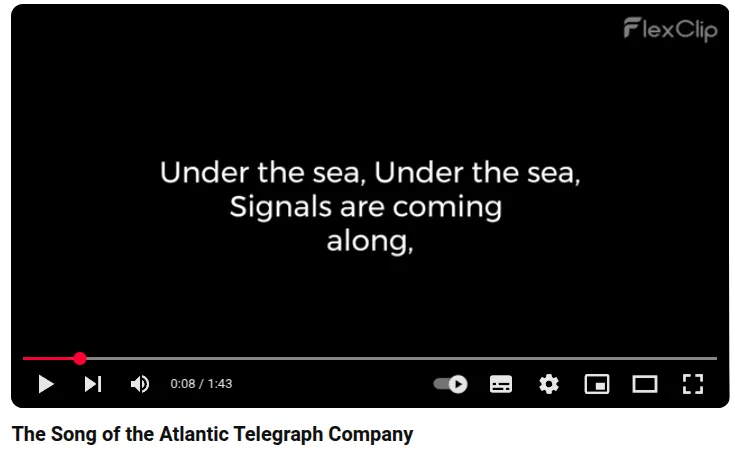
From here, a humble contribution: I took the mp3 that appears on the Atlantic Cable site, made by David Morton. It is music made on the sheet music of "Over the sea," by Mr. Groom, the song on which Maxwell wrote his poem.
Then I used the FlexClip site to transform text to speech, with the text published above. With the narration and music combined, I made this short video
The Song of the Atlantic Telegraph Company:
https://youtu.be/6Z1nQGZ8EYQ
CONCLUSION
James Clerk Maxwell wrote an ode, not to a cable, but to the Odyssey of knowledge: from the abstract world of mathematical ideas to the communicative interconnection of the globe. Whether we then make good or bad use of that is another story.☉
Sources and related links
The Song of the Atlantic Telegraph Company https://atlantic-cable.com/Article/UnderTheSea/index.htm#gsc.tab=0
About the images
Screenshot.