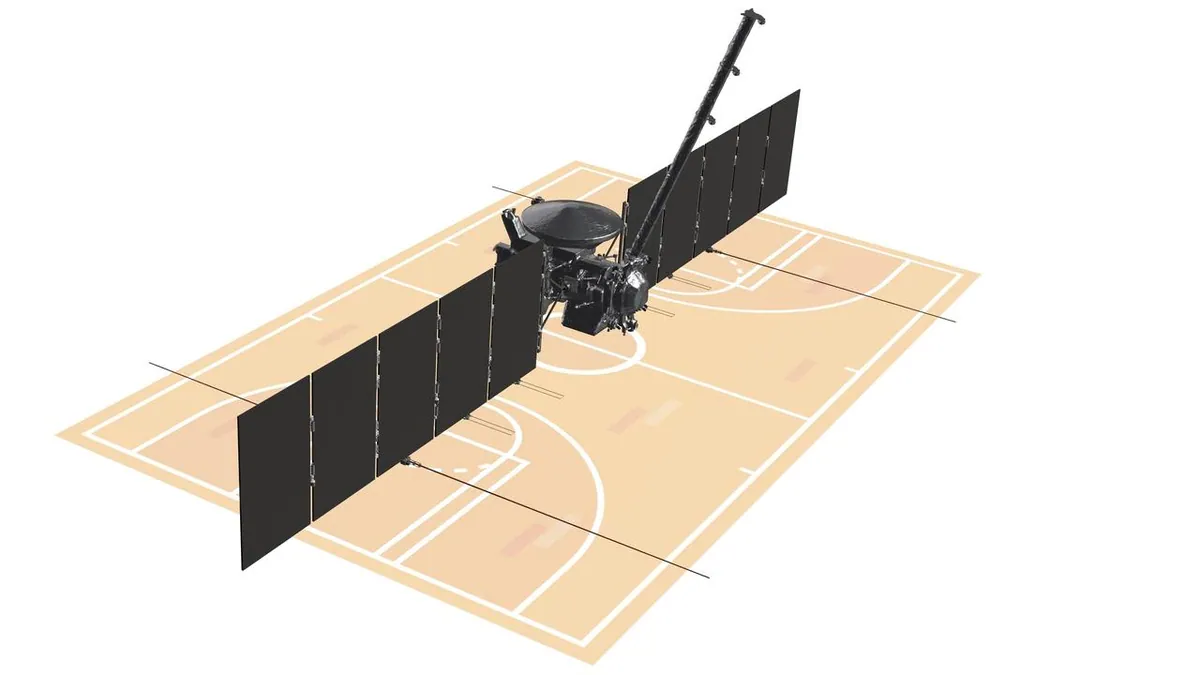
NASA's Europa Clipper spacecraft will perform a close flyby of Earth on December 3, a critical maneuver to accelerate its journey to Jupiter. The closest approach will occur west of Africa at 3:14 p.m. Eastern Standard Time, at a distance of between 3,140 and 3,450 kilometers. This flyby, known as a gravity assist, will use our planet's gravity to propel the spacecraft, the largest NASA has launched into deep space, toward its final destination. The mission aims to investigate whether the subsurface ocean of Jupiter's moon Europa contains the ingredients necessary for life, and it is expected to arrive at Jupiter in April 2030.
The Europa Clipper mission teams will compare data gathered during the Earth flyby with existing information about our planet. This will allow them to make necessary adjustments to their scientific instruments. Erin Leonard, a scientist at JPL and a member of the project team, stated that they are practicing the intricacies of the operation, but also rehearsing how to work together to produce the best science. Leonard added that the things they practice now will set them up for success at Europa. The spacecraft's eleven scientific instruments will be turned on and gather data during this flyby, which is a fundamental milestone for the mission.
The calibration work during the Earth flyby is especially important for Europa Clipper's magnetometer. This instrument is designed to confirm the existence and study the properties of Europa's subsurface ocean. Robert Pappalardo, the project scientist at JPL, explained that the magnetometer measures variations in the magnetic field while orbiting Jupiter, but they need to link these observations to something known to understand the actual values it measures. Pappalardo noted that the flyby will allow them to calibrate the instrument absolutely, using its observations of Earth's well understood magnetic field to refine other calibrations.
The spacecraft's magnetometer is one of the most important instruments for confirming the existence of a subsurface ocean on Europa. This instrument will be able to determine the depth and even the salinity of that ocean, in addition to helping measure the thickness of the ice shell. Europa sits inside Jupiter's vast and powerful magnetic field, which constantly varies. If a salty, conductive ocean exists, it will generate a secondary magnetic field, creating a complex puzzle of fields that the magnetometer is designed to solve.
The Europa Thermal Emission Imaging System (E-THEMIS) will scan Earth every eight hours during the approach, a practice for its task of locating warm regions on Europa's surface where subsurface water might be closer. The Ultraviolet Spectrograph (Europa-UVS) will study Earth's atmosphere, and its observations will be compared with those made simultaneously by the LAMP instrument aboard NASA's Lunar Reconnaissance Orbiter. Kurt Retherford, principal investigator for the UVS instruments, said that Europa has its own type of atmospheric corona, composed of hydrogen and other atoms escaping into space. He said these observations of Earth carried out by different spacecraft from different viewpoints serve as a good rehearsal for how they intend to do the same at Jupiter.
Robert Pappalardo described that they are coming down into the gravity well of Earth, following its curve, and shooting out again. He said the spacecraft is able to get pulled by the gravity of the planet and continue on its way, now with a slightly changed trajectory and moving faster than it was before. These gravity assists are essential to save the spacecraft's valuable fuel. The fuel is conserved primarily for the critical orbital insertion at Jupiter, the single largest burn of the mission. From locations near the closest approach trajectory, particularly in southern Europe and Africa, Europa Clipper might be visible with relatively large backyard telescopes during its passage.
The findings will help scientists assess the habitability potential of worlds beyond Earth. Erin Leonard stated that it is very exciting when they manage to gather data that is truly meaningful for the instruments and they can share it with other people. She said it is about Earth, and everyone understands what that data means, and to imagine what they will be able to reveal about Europa. The Europa Clipper mission is being developed by JPL in collaboration with the Johns Hopkins Applied Physics Laboratory for NASA's Science Mission Directorate.