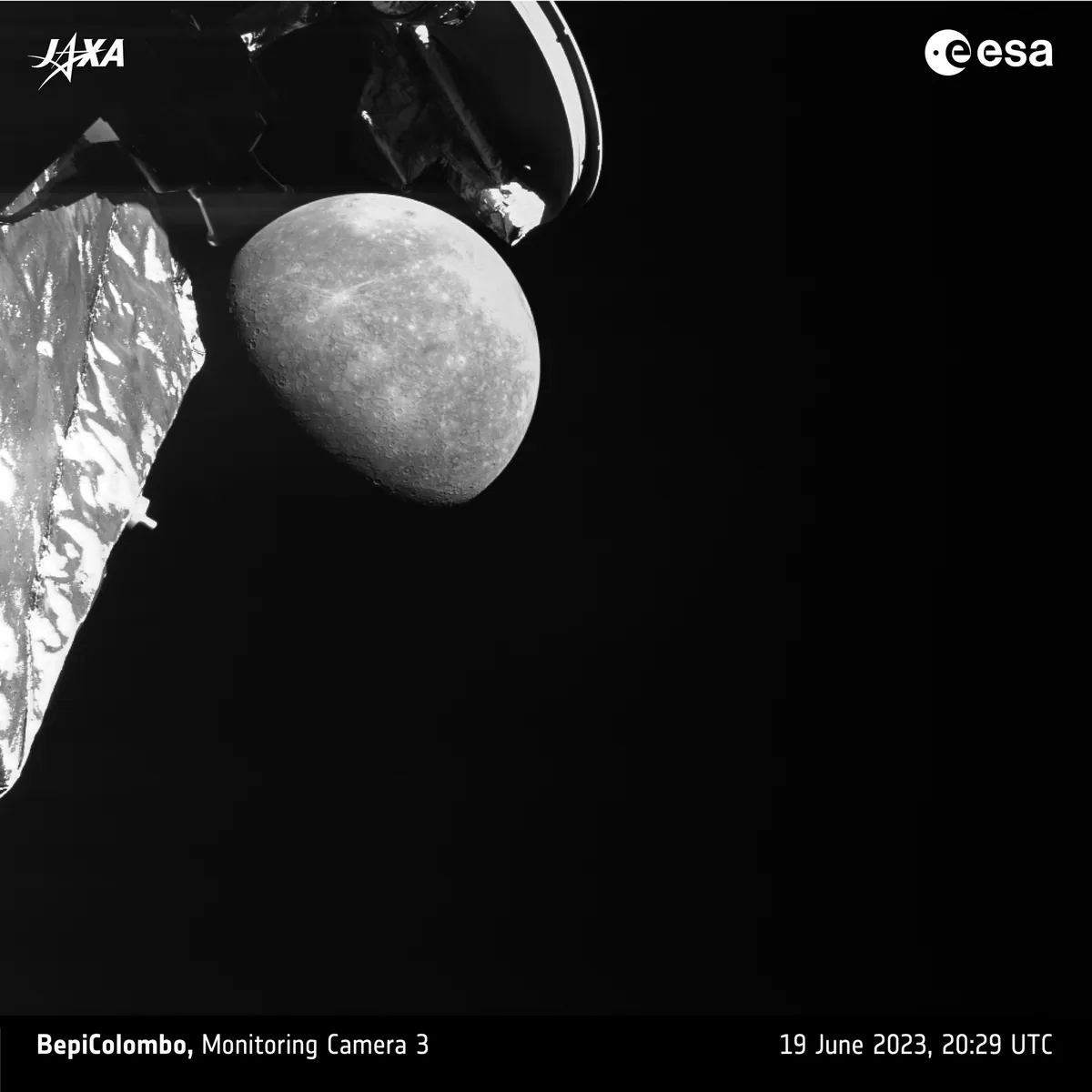
The joint ESA and JAXA BepiColombo mission successfully inserted itself into orbit around Mercury on November 21. This milestone was achieved despite a software glitch that interrupted the main burn earlier than planned. The probe, after an eight-year journey, is now in a stable orbit and teams have adapted the flight plan. The next key phase is the separation of its two science orbiters on December 9.
The BepiColombo mission was first proposed to ESA in 1993 and selected for development in 2000 as part of the Horizon 2000+ program. The spacecraft manufacturer, Astrium (now Airbus Defense and Space), was selected in 2007. A launch on a Soyuz rocket was initially planned, but due to a mass increase an Ariane 5 was chosen. Development faced several delays, with an initial launch date in 2014 that was repeatedly postponed until 2018.
Subsequent analysis revealed the burn stopped autonomously and prematurely, achieving only around 77% of the total planned velocity change. The investigation, conducted by teams from ESA and spacecraft manufacturer Airbus, traced the problem to a software glitch related to orientation and thruster control. Despite the interruption, the maneuver was sufficient for Mercury's gravity to capture the probe. Frank Budnik, ESA's BepiColombo Flight Dynamics Manager, confirmed orbital capture around 01:00 local time on November 22.
Instead of the initially planned 58-hour orbit, BepiColombo ended up in a 75-hour orbit around the planet. Flight dynamics teams have already adapted the sequence of remaining maneuvers to this new trajectory, with no additional burns required. These changes do not affect the separation of the Mio orbiter on December 9 or the MPO's ability to reach its planned science orbit. BepiColombo's orbital insertion used a technique known as 'weak stability capture', which involves arriving at the planet at lower speeds than usual, a method previously only used by some missions to Earth's moon.
The MOI sequence was designed to be flexible, with multiple short burns scheduled over the coming months to gradually and efficiently adjust the orbit. According to Frank Budnik, if it were done with fewer burns, there would not be enough propellant to achieve the goal due to what is called "gravity loss". Several shorter burns allow BepiColombo to repeatedly take advantage of the optimal point, when it is closest to Mercury, minimizing these losses. After each burn, the Flight Dynamics team determines the achieved orbit to design the next maneuver, allowing each subsequent burn to be adapted to the spacecraft's actual trajectory.
The next major milestone is the separation of the two science orbiters, ESA's MPO and JAXA's Mio, scheduled for December 9. Main science operations will begin in April 2027. The separation remains scheduled despite the software incident. The orbit changes do not affect the planned separation.
BepiColombo was launched on October 20, 2018, on an Ariane 5 rocket from Kourou, French Guiana. Its eight-year journey included nine gravity-assist flybys: one of Earth, two of Venus, and six of Mercury itself. Arrival into Mercury orbit was originally planned for December 2025 but was delayed by almost a year due to an electrical problem in the propulsion system discovered in April 2024, which forced the adoption of a revised trajectory. The mission also overcame a memory error increase caused by a solar flare in May 2024. After the separation of its two orbiters, BepiColombo will become the first mission to operate two spacecraft simultaneously in orbit around Mercury.
During its journey, BepiColombo performed an Earth flyby in April 2020 at an altitude of 12,700 kilometers. The spacecraft also completed two Venus flybys, the first on October 15, 2020, at an altitude of 10,720 km and the second on August 10, 2021, at only 552 km. This second Venus flyby occurred just 33 hours after ESA's Solar Orbiter mission completed a similar gravity assist at the same planet. In total, the mission performed nine gravity assists, including one at Earth, two at Venus, and six at Mercury, following a complex trajectory to its destination.