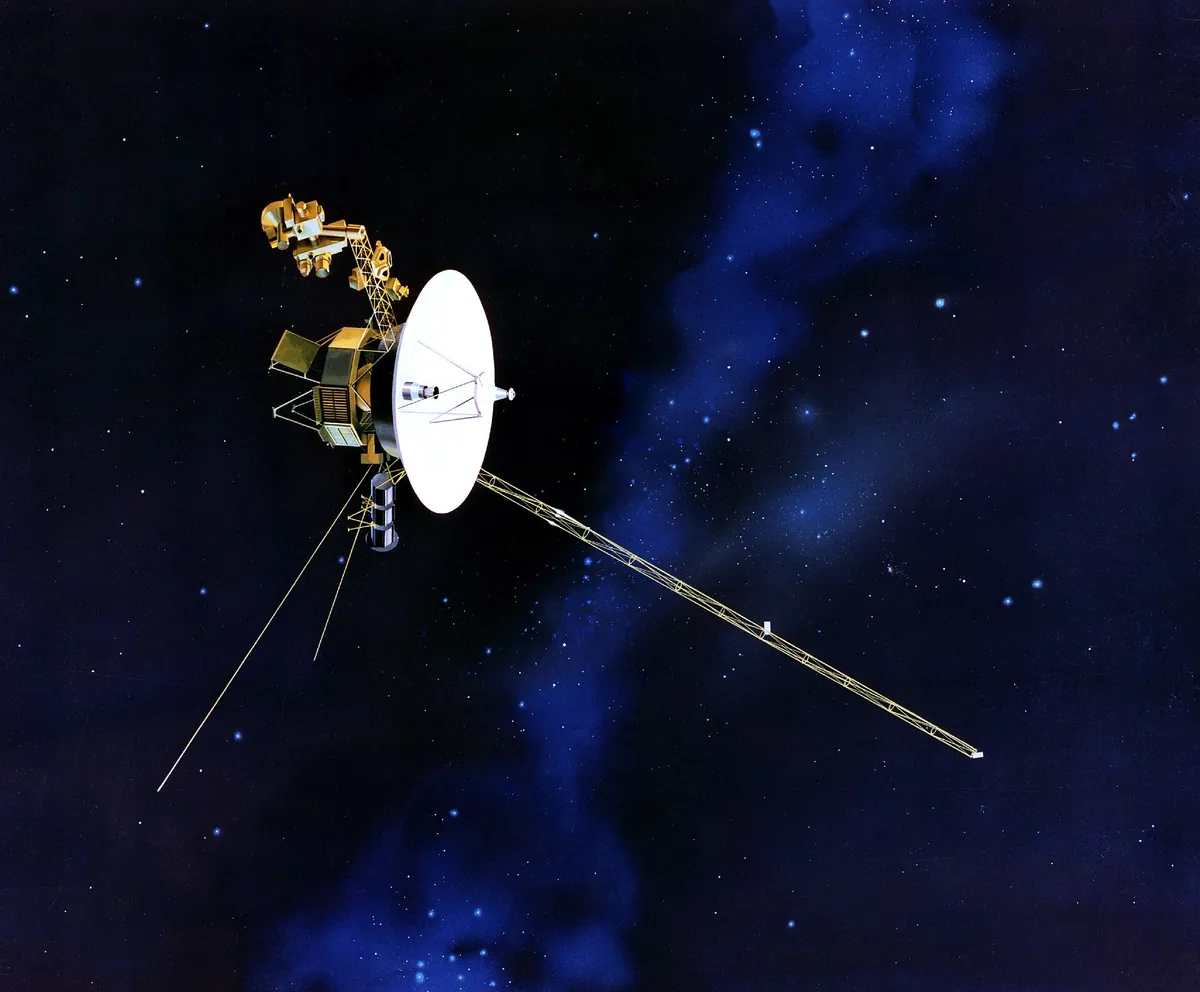
NASA's Voyager 1 probe, the most distant human-made object, reached the distance of one light-day from Earth on November 18. The milestone occurred at 5:16:07 a.m. EST (10:16:07 UTC), when the spacecraft was about 25.9 billion kilometers from our planet. A light-day is the distance light travels in 24 hours, equivalent to about 16.1 billion miles. The mission team at NASA's Jet Propulsion Laboratory (JPL) confirmed the achievement using the spacecraft's carrier signal and trajectory calculations, as the probe has stopped sending science and engineering data since November 14.
Dave Gallagher, director of JPL, said that crossing the one light-day threshold is yet another historic feat on an extraordinary voyage of discovery. Gallagher noted that the milestone stands as a testament to the exceptional teams who built, programmed, and fly these spacecraft today, and who have overcome countless challenges to keep them connected to Earth across the vastness of space. Radio signals, which travel at the speed of light, now take 24 hours to reach Voyager 1 and another 24 hours to return to Earth. Joe Westlake, director of the Heliophysics Division at NASA Headquarters in Washington, explained that traveling a light-day is a singular feat for a spacecraft, but that Voyager is so much more than a distant traveler. According to Westlake, the Voyager mission would be remarkable just for what it contributed to planetary science with the Grand Tour of the outer planets, but it went on to become central to NASA's fleet of heliophysics missions, offering insights into the Sun.
Voyager 1 and its twin, Voyager 2, are humanity's only probes in interstellar space. They were launched in 1977 to take advantage of a rare planetary alignment. Voyager 1 became the first spacecraft to leave the heliosphere, the bubble of particles and magnetic fields created by the Sun, and enter interstellar space in 2012. Voyager 2 crossed that boundary in 2018. Both continue to measure changes in the Sun's magnetic field across vast distances.
Linda Spilker, Voyager project scientist at JPL, said that the Voyagers are revolutionizing our understanding of interstellar space, a previously unexplored region outside the heliosphere. Spilker added that one big surprise is the extent to which the Sun continues to affect interstellar space, all the way out to Voyager 1, and she wondered where the solar influence ends and pristine interstellar space begins, suggesting that perhaps Voyager can last long enough to answer that question. Creative engineering solutions have allowed the probes to conserve power and overcome challenges related to aging hardware. Earlier this year, engineers successfully turned off three devices on Voyager 1 and replaced them with three lower-power alternatives, a move not without risk, to help the spacecraft make the most of its 50-year-old radioisotope thermoelectric generator. This generator, essentially a nuclear battery, converts heat from decaying plutonium into electricity.
With the plutonium supply continuously depleting, both Voyager probes lose about 4 watts of power each year. The latest power-saving effort should provide enough power for both spacecraft to keep their current set of scientific instruments operational at least until their 50th launch anniversaries next summer. Suzanne Dodd, Voyager project manager at JPL, explained that they listen to Voyager 1 every day and send commands to the spacecraft weekly, and that it simply takes a little longer to communicate than before. Kareem Badaruddin, Voyager's interstellar mission manager, reflected on the unique nature of the mission, comparing it to a relay race where he just carries the baton for now, after thousands did before. Badaruddin said it has never happened before and it may never happen again.
In addition to their scientific instruments, the Voyager probes carry a Golden Record, a gold-plated copper phonograph compiling images and sounds from Earth, as a message to any advanced civilization that might one day find it. Ray Jayawardhana, president of Caltech, which manages JPL, said that nearly half a century after leaving Earth, the Voyager mission continues to push the boundaries of human exploration. Voyager 2, which took a different trajectory and studied Uranus and Neptune, is currently more than 13.4 billion miles from Earth, with messages taking about 20 hours to arrive. It is expected to reach the one light-day distance in November 2035. Communication with both probes is managed by NASA's Deep Space Network, large antennas located at three facilities around the world.