Chile positioned itself at the center of world astronomy research thanks to the clear skies of its northern region, where the most advanced and powerful observatory on the planet is located at Cerro Paranal, soon to be joined by the first global radio astronomy project, ALMA, both dedicated to exploring the origin of the Universe.
Via Correo del Caroní
Scientists chose the location -in the vast Atacama desert-, due to the privileged conditions it offers for nighttime observation, with a clean atmosphere, scarce rainfall and low humidity for most of the year.
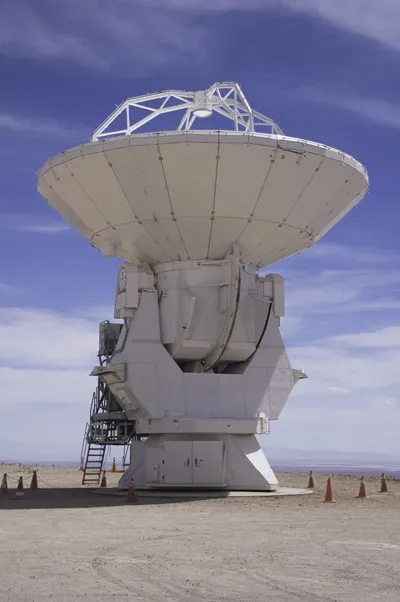
Separated by almost 400 km are the Cerro Paranal Observatory, near the city of Antofagasta, and on the Chajnantor Plateau, near San Pedro de Atacama, the APEX radio telescope, the starting point of the largest global astronomy project, the Atacama Large Millimeter/submillimeter Array (ALMA).
These are the most advanced centers in a network of other observatories in northern Chile such as Tololo, La Silla or Las Campanas.
The atmospheric conditions allow at Cerro Paranal, located about 1,100 km from Santiago and at 2,635 meters in altitude, observations to be made at least 350 nights a year, in sessions of between 10 to 12 hours.
That pace enables astronomers to work uninterruptedly in the search for answers to the questions that have always accompanied humanity: when and how the Universe formed, or if extraterrestrial life exists.
"Knowing how and when our Universe formed or if we are alone, are the most important questions we have to investigate," French astronomer Christophe Dumas told AFP.
There are also no certainties about eventual extraterrestrial life: "we don't believe in UFOs (unidentified flying objects), although we think there is a high probability that intelligent life exists elsewhere in the Universe," explained Dumas.
"It could be that many UFO phenomena are true, because there are many issues we still don't know, for which we don't have an answer and that need to be investigated," said Chilean astronomer Miriam Peña for her part.
The astronomers at Paranal have the highest-resolution optical instrument developed to date, the Very Large Telescope (VLT).
The VLT is composed of four large telescopes 30 meters high, each equipped with a primary mirror 8.2 meters in diameter, 18 cm thick and weighing 23 tons, which operating together allow them to observe a man walking on the Moon.
The Paranal astronomical complex, operated by the European Southern Observatory (ESO), is in high demand by scientists, so observation hours are worth gold.
On average the Observatory accommodates the development of only one out of every five projects that are submitted, explained ESO's public relations officer, William Garnier. "For the rest, unfortunately, there is no time left," he specified.
Ambitious project
By 2011 the Atacama Large Millimeter/submillimeter Array (ALMA) will be operating in the Chilean altiplano, the first global astronomical project aimed at studying the origin of the universe.
The observatory is in the full construction phase and when it reaches its full operational capacity it will have a resolution 10 times superior to the Hubble Space Telescope.
The project envisions the installation of at least 64 antennas 12 meters in diameter on the Chajnantor Plateau, in the middle of the Atacama Desert, about 1,700 km north of Santiago and at more than 5,100 meters in altitude.
The location -extremely dry with an average rainfall of 10 millimeters per year-, offers the best known conditions for radio astronomy, which explores the Universe through the radio waves from galaxies, stars, quasars and other bodies.
That capacity to capture waves gives the antennas advantages over telescopes, which capture light through mirrors, and fuels hopes in the international scientific community that attempts through ALMA to reach the most remote areas of the Universe.
"It will be a giant eye, unique for its potential to receive data about the birth of the Universe," William Garnier, public relations officer for the European Southern Observatory (ESO), which is part of the project, told AFP.
ALMA will also study the formation of galaxies similar to the Milky Way, new planets forming around young stars in our galaxy and the birth of new stars in the midst of clouds of gas and dust, among other celestial objects.
The array of radio telescopes is the first global astronomical project, involving Europe, the United States and Japan, in cooperation with Chile.
The program has an estimated budget of more than 600 million dollars, contributed mainly by the Associated Universities Incorporated (AUI) consortium of the United States and the ESO Observatory, which comprises 11 European countries.
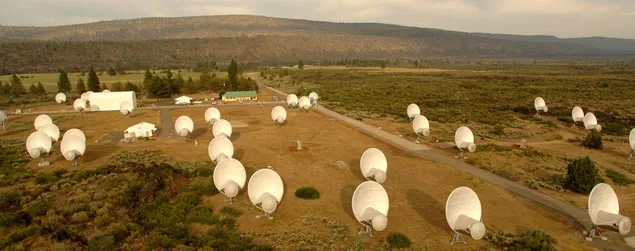
The future antennas will be able to operate in different configurations, depending on the scientists' requirements. The least extended configuration will have a diameter of 150 meters (the antennas very close together) to explore very wide fields such as galaxies or large dust clouds.