In the Atacama region of Chile, one of the world's most advanced telescopes has just achieved a first milestone. The first of many antennas has been placed for the ALMA project, which is being built on the Chajnantor plateau at an altitude of 5,000 meters.
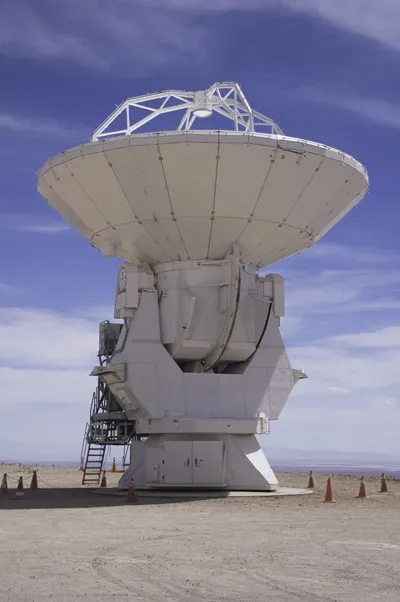
ALMA, a project whose name comes from Atacama Large Millimeter/submillimeter Array, will have 66 high-precision antennas, although this number can be expanded. There will be an array of 50 antennas of 12 meters, acting together as a single telescope and a compact array composed of antennas 7 and 12 meters in diameter.
With ALMA, astronomers will study the cold universe: the molecular gas and tiny dust grains from which stars, planetary systems, galaxies, and even life are formed. It will thus provide much-needed knowledge about the formation of stars and planets and reveal distant galaxies in the early universe.
The first 12-meter antenna, built by Mitsubishi Electric Corporation for the National Astronomical Observatory of Japan, one of ALMA's partners, has been placed. It will soon be joined by other European and North American antennas.
The antennas will undergo a series of tests to ensure they meet the telescope's strict requirements. The transfer of the antenna is a major milestone, and now the observatory team will be able to integrate the rest of the components, including the sensitive receivers that will collect the faint cosmic signals. The antennas are tested at an operations facility at 2,900 meters altitude before being transferred to Chajnantor.
The site was chosen for its extreme dryness and altitude, which offer excellent observing conditions, and it is also sufficiently large for the installation of the antenna array.
The antennas, which weigh about 100 tons each, can be moved to different positions to reconfigure the telescope. This will be possible thanks to two colossi: these are specially designed transporters, which are 10 meters wide, 20 meters long, and have 28 wheels.

ALMA will operate at wavelengths from 0.3 to 9.6 millimeters. At these wavelengths, a high and dry site is necessary for the telescope to "see" through Earth's atmosphere. Resolutions of up to 0.005 arcseconds can be achieved at the shortest wavelengths, a factor of 10 times better than the Hubble Space Telescope!
Sources and related links
- ALMA observatory equipped with its first antenna
- More materials: Videos, photos and interviews about ALMA
About the images
Credit: ALMA (ESO/NAOJ/NRAO).