What follows is a small excerpt from a document of the Asociación Argentina de Astronomía Reunión Anual, 2006 Comité Editorial that can be read in full on the Association's website.
Abstract:
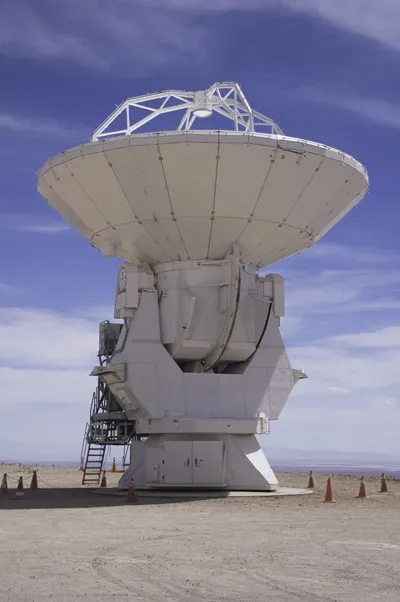
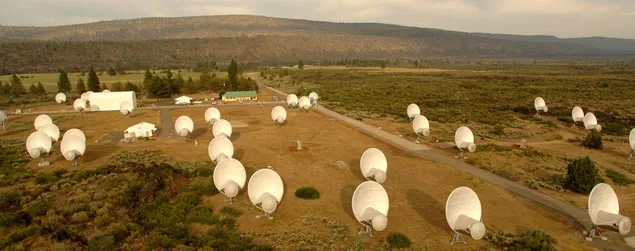
This work succinctly describes the scientific objectives and technical characteristics of an aperture synthesis interferometer. This instrument would be designed to work in the frequency range of 500 Mhz to 700 Mhz.
General Introduction
Radio astronomy opened the first electromagnetic window outside the optical range, providing a new vision of the universe and discovering a great variety of phenomena that were not accessible to conventional telescopes. Among the discoveries made with radioastronomical techniques, we can mention the finding of the cosmic background radiation, the determination of the distribution and kinematics of neutral hydrogen in space, the existence of radio galaxies, quasars, pulsars, millisecond pulsars, microquasars, as well as the establishment of the structure of the diffuse continuous emission of the galaxy.
Argentine Astronomy has been developing radioastronomical studies for just over four decades, since the creation of the Instituto Argentino de Radioastronomía (IAR) in 1962. Currently, the IAR has two 30 m radio telescopes, operable at frequencies from 1.4 to 3.3 GHz, in line and continuum observation modes. The angular resolution [RA] of these instruments is 34' at 1.4 GHz and 12' at 3.3 GHz. With them, important surveys of the southern sky have been carried out, in addition to contributing with databases that allowed numerous studies on individual objects to be carried forward.
Although in the Northern Hemisphere there is a large quantity and variety of radioastronomical instruments, this is not the case in the Southern Hemisphere. This aspect makes the idea of developing a new instrument attractive.
New instrumentation?
Taking into account the existing or planned radioastronomical observation instruments worldwide, and restricting ourselves to a strictly scientific plane, to plan the design, construction and operation of a new instrument that implies a quantitative leap -due to the possibilities it may offer- for researchers, one should:
• Clearly identify those areas in the field of scientific research in which a new instrument could be competitive due to angular resolution, sensitivity and possible scientific contributions.
• Consider the feasibility of design and construction within a reasonable timeframe, so the use of the available technological "know-how" in the country should be maximized.
• Locate the new instrument in a geographical region of the country where electromagnetic pollution is compatible with the sensitivity levels intended to be achieved.
The first two aspects, with strong influence from the second, indicate that the instrument should operate in the low-frequency range (wavelengths from a few centimeters to a few tens of centimeters). The last of the requirements makes it advisable to locate it near the current site of the Complejo Astronómico El Leoncito (CASLEO), located in the province of San Juan.
Additional important considerations
Regardless of the virtues and benefits that could come from using a new instrument, before being able to use it, it must be carefully designed, funding sources found, and then built. This implies the need to have a critical mass of researchers, engineers and technicians so that the project can be executed.
Being a radioastronomical instrumentation project, it seems reasonable that the technical staff of the IAR play an important role. As of today, the necessary technical critical mass is not available at the IAR; see articles Arnal 2006 (p. 29) and Sanz 2006 (p. 47) in the Proceedings of the Workshop Astronomía Observacional en Argentina: Problemas y Perspectivas, www.astronomiaargentina.org. As mentioned in the same Workshop, reversing this situation is feasible, but it depends on a scientific policy decision that must be made at the level of the highest authorities of the national scientific-technological system. If deemed appropriate, the Assembly of the A.A.A. could take some action in this regard.
4. Scientific Projects
Recently, instruments operating on board satellites have detected non-thermal sources at high energies such as microquasars, plerions, supernova remnants, molecular clouds interacting with cosmic rays, blazars, etc. All these sources emit radiation produced by relativistic particles, which should also radiate at the other end of the spectrum by synchrotron mechanism. For this reason, radio studies with sufficient angular resolution are fundamental to establish the physical properties and identify the characteristics of the particle populations responsible for the high-energy radiation. In the coming years, between hundreds and thousands of new sources will be discovered by the new generation gamma telescopes.
A radio telescope with arcminute resolution will allow, among other things, studying the nature of these sources, as well as conducting surveys of the galactic plane, polarization studies to obtain information about the magnetic field (orientation and spatial distribution) of different classes of objects, etc. Likewise, a new interferometric instrument will manage to renew and extend Argentine radioastronomical instrumental capacity substantially, expanding research fields and strengthening the training of human resources in technological areas. The development will cause direct repercussions on the technology transfer activities carried out by institutes that become involved in the development of this new instrument.
5. Feasibility, Human Resources and Transfer
In addition to having the collaboration of the Canadian group that built and operates the DRAO, the IAR has extensive own experience, fundamental in technological development in the area of radio frequencies (Antenna I and Antenna II radio telescopes, developments for third parties such as radiometers at 23.8 and 36.5 GHz for the SAC-D Project, antenna prototype, dividers and phase shifters for the SAOCOM radar, etc., see www.iar.unlp.edu.ar/ES /transferencia.htm and /desarrollo.htm).
The first developments could use the pre-existing infrastructure at the IAR.
It is expected that the project will produce a significant amount of human resources, both in technological areas (engineers, technicians) and scientific ones (radio astronomers), multiplying diploma works and Bachelor's Theses in both branches.
The requirements for developing increasingly complex observational instrumentation will result in the formation of a highly skilled set of technical personnel, whose knowledge has direct transfer to areas of technological activity that are not directly linked to astronomical research, and in which a high economic return rate can be found (for example, in the area of developing key technological parts in satellites).