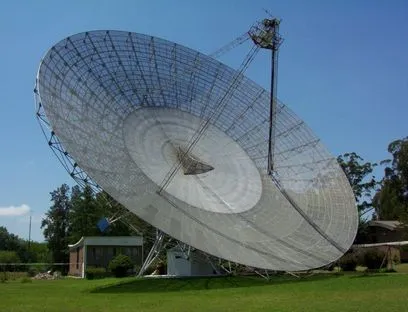
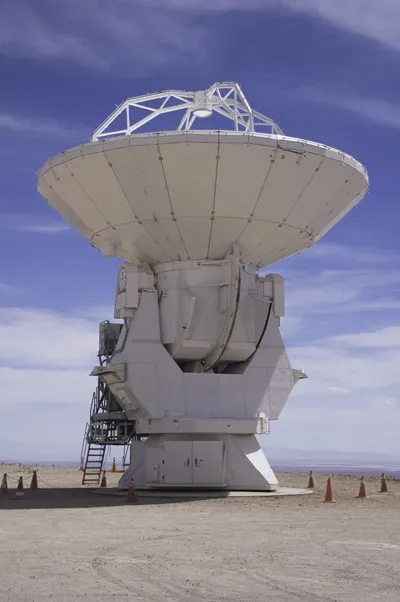
The Allen array results aim to demonstrate that the current 42 antennas work as they should and they made some images for that purpose. A series of documents had already been presented at the June astronomers' meeting and now a new document was presented. But there are still no E.T. signals.
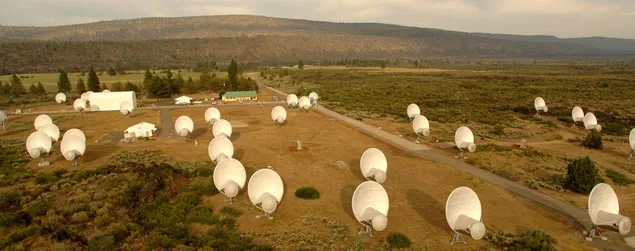
The Allen telescope array (Allen Telescope Array, ATA) is named for its benefactor, Microsoft co-founder Paul Allen. It is a project of the SETI Institute and the University of California, Berkeley, designed for the search for extraterrestrial life and will comprise 350 antennas. Currently, it has only 42 antennas, which still gives it a very large field of view. It uses 6-meter antennas that, together, can observe five square degrees of the sky at the same time.
One question ATA tries to answer is the mystery of the missing gas. Star-forming regions do not seem to have enough molecular gas to sustain the observed star formation rates.
Some researchers think atomic hydrogen makes the difference. The ATA team has searched for it in four galaxy groups so far, but found nothing.
"This paper was our first scientific report, so we have answered some questions, but we have found more," commented Joeri van Leeuwen of ATA.
The surveys allow running several projects at the same time, through different wavelengths. So they can check foreground stars for signs of extraterrestrial intelligence, while observing background galaxies in search of atomic hydrogen clouds.
To be able to detect more diffuse and distant objects, the array must be expanded, for which funds are required.
Jill Tarter, director of the SETI Institute indicated that last week they sent a proposal to the U.S. National Science Foundation (NSF) to double the size of ATA. The telescopes can cost between 150 thousand and 250 thousand dollars, depending on how many are ordered, and completing the array would cost 40 million U.S. dollars.
Meanwhile, Tarter hopes to leverage the "wisdom of the crowds" to optimize data analysis. She plans to make the detection algorithms open source so engineers around the world can help improve them. And she wants to enlist volunteers to study visualizations of the radio data.
"We want to put the signals in front of the eyes of the world, have people tell us if they see patterns, make a decision on whether there is an interesting signal in the data and return to the observatory in time to make changes to the telescope," she explained.
That would be an improvement over the SETI@home project because it would involve people's minds, not just their hardware and software resources.
"I can't encourage you to look in a more cosmic perspective unless you are really intellectually involved," she commented.
Results
At the June 2009 American Astronomical Society meeting, eight papers were presented demonstrating the array's capability in surveys of the galactic center and radio astronomy surveys. (Linked below).
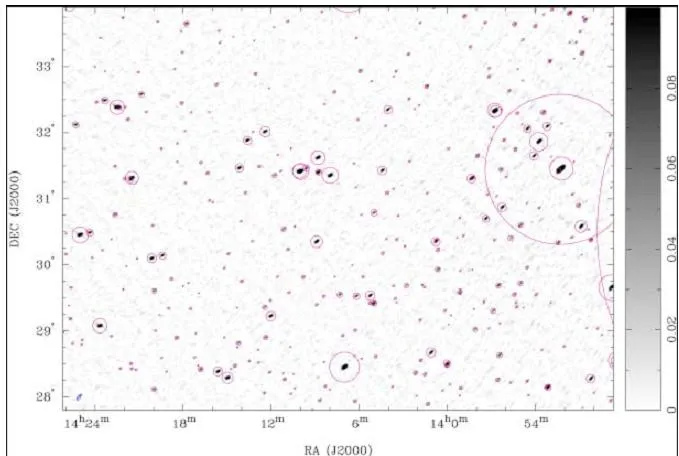
In the work recently submitted to Proceedings of the IEEE (Proceedings of the Institute of Electrical and Electronics Engineers) the team indicated that to demonstrate the great capability of the array they made a mosaic of radiation at a frequency of 1.4 GHz, integrating 350 separate points to produce an image of 800 square degrees in size or 2% of the sky. Several thousand sources were detected there, mainly jets or relativistic jets associated with massive black holes in distant galaxies. A section of the mosaic, made with 10 points, approximately 25 square degrees in size is shown below. A single observation of the complete mosaic can be made in 8 hours.
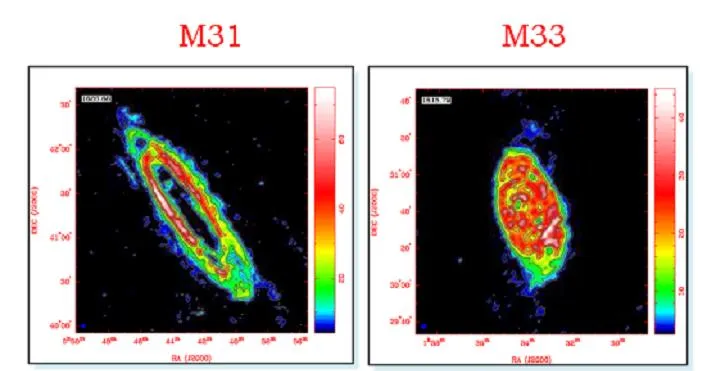
Two of the bright galaxies in the Local Group, M31 (Andromeda) and M33, are also shown in the paper, in the neutral hydrogen emission line.
How ATA was born
The idea for ATA arose in a series of seminars at the SETI Institute in 1997 to define the path for future technology development and strategies. Advances in computing and communications made it clear that arrays of Large Numbers of Small Dishes (LNSD) were more efficient and less expensive than traditional antennas. In the end, the construction of the 1HT, the one-hectare telescope, was recommended. One hectare is an area equivalent to a square 100 meters on a side.
In the search for funds for 1HT, Paul Allen agreed to provide what was necessary for technological development and the first phase of construction (42 antennas). In October 2007 the array began testing and observations.
It is currently used for radio astronomy observations of our galaxy and others, gamma-ray bursts and the search for extraterrestrial life.
The Allen Telescope Array at the Hat Creek Radio Observatory http://www.youtube.com/watch?v=5qmmZKMN7WA
Sources and related links
- SETI telescope array produces first science results by Lisa Grossman
- The Allen Telescope Array: The First Widefield, Panchromatic, Snapshot Radio Camera for Radio Astronomy and SETI
Welch, W. J. Backer et al.
Proceedings of the IEEE, August 2009, Volume 97, Number 8
DOI: 10.1109/JPROC.2009.2017103
arXiv:0904.0762v1 - ATA: Papers from Scientific Meetings
About the images
- Image of the Allen array. Credit: ATA
- Images from the paper to IEEE. Credit: Welch, W. J. Backer et al., ATA team