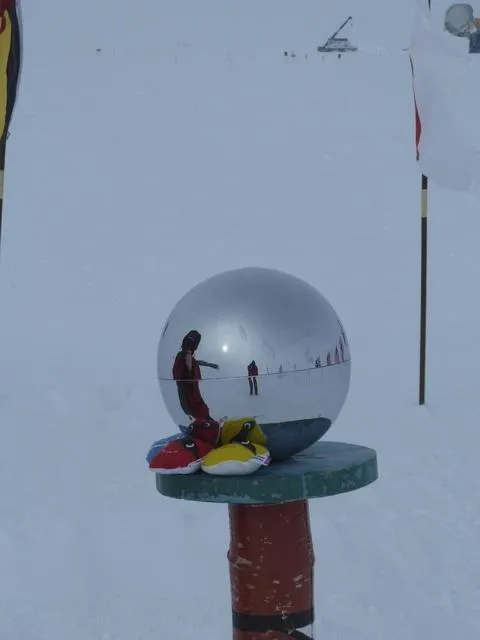
New papers from the Auger Collaboration, the international team studying cosmic rays from Mendoza, have been published. And we take the opportunity to publicize the existence of files to visualize the experiment in Google Earth.
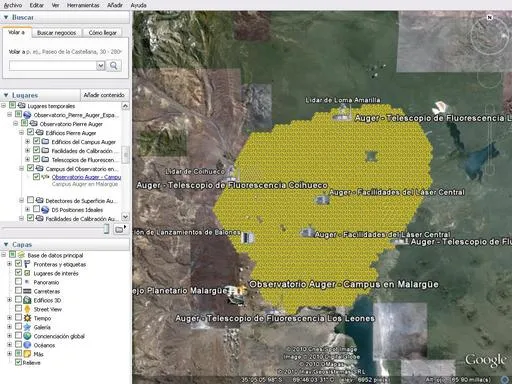
The Auger sur site consists of a network of 1,600 detectors spaced 1.5 km apart and covering a total area of 3,000 km2 in Malargüe, Mendoza Province.
The objective is to determine the nature, energy and arrival direction of cosmic ray particles with energies above 10^19 eV. For this they created a surface network of water Cherenkov detectors and a system of atmospheric fluorescence telescopes for observing showers.
Furthermore, the Auger Norte site is under construction in Colorado, United States, which will have 3,500 detectors.
The papers
In these recently published works (2010), measurements of the cosmic ray flux with unprecedented precision are reported. The articles are signed by the Collaboration, made up of 370 scientists from 17 countries.
Measurement of the energy spectrum of cosmic rays above 10^18 eV using the Pierre Auger Observatory arXiv:1002.1975v1
Measurement of the Depth of Maximum of Extensive Air Showers above 1018 eV
Phys. Rev. Letters 104 (2010) 091101.
arXiv:1002.0699v1
Trigger and Aperture of the Surface Detector Array of the Pierre Auger Observatory
Nucl. Instr. and Methods in Physics Research A613 (2010), 29-39.
Volume 613, Issue 1, 21 January 2010
2010NIMPA.613...29A
A Study of the Effect of Molecular and Aerosol Conditions in the Atmosphere on Air Fluorescence Measurements at the Pierre Auger Observatory arXiv:1002.0366v1
Astroparticle Physics: 10.1016/j.astropartphys.2009.12.005
The northern site of the Pierre Auger Observatory
New Journal of Physics, Volume 12
DOI: 10.1088/1367-2630/12/3/035001 http://www.augernorth.org/
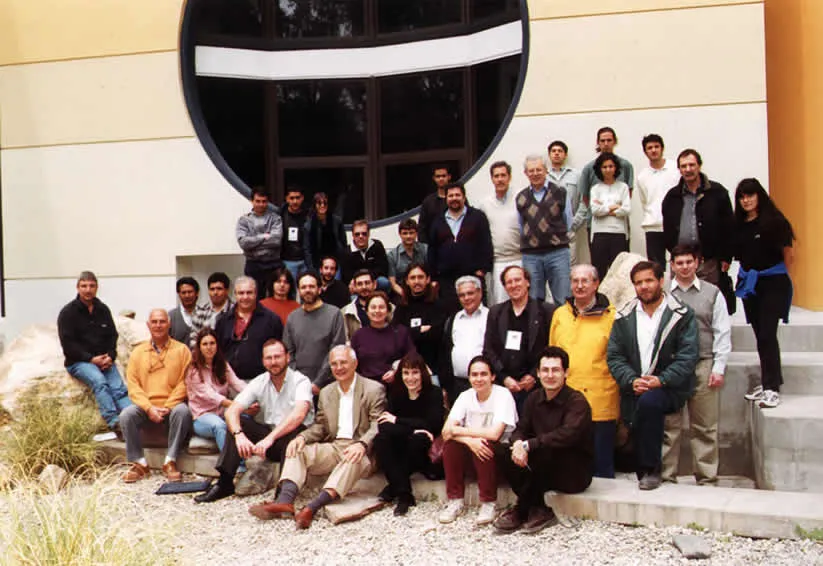
The Argentine collaboration
I. Allekotte, H. Asorey, X. Bertou, G. Golup, M. Gómez Berisso, D. Harari, S. Mollerach, V.H. Ponce, E. Roulet, (Centro Atómico Bariloche e Instituto Balseiro (CNEA-UNCuyo-CONICET), San Carlos de Bariloche, Argentina)
E. Colombo, A. Filevich, A. Etchegoyen, R.F. Gamarra, D. Ravignani, O. Wainberg, B. Wundheiler, M.I. Micheletti, F. Sánchez, A. Ferrero, A. Tapia, M. Platino, A. Lucero(Centro Atómico Constituyentes (Comisión Nacional de Energía Atómica/CONICET/UTN-FRBA), Buenos
Aires, Argentina)
J. Pallotta, E.J. Quel, P. Ristori, (Centro de Investigaciones en Láseres y Aplicaciones, CITEFA y CONICET, Argentina)
Y. Guardincerri, R. Piegaia, J. Tiffenberg, (Departamento de Física, FCEyN, Universidad de Buenos Aires y CONICET, Argentina)
D. Badagnani, M.T. Dova, F. Gomez Albarracin, P. Hansen, A.G. Mariazzi, J.C. Moreno, S.J. Sciutto, T. Tarutina, M. Tueros, H. Wahlberg, (IFLP, Universidad Nacional de La Plata y CONICET, La Plata, Argentina)
A.C. Rovero, (Instituto de Astronomía y Física del Espacio (CONICET), Buenos Aires, Argentina)
M. Videla, B. García, G. De La Vega, (UTN Mendoza (CONICET/CNEA), Mendoza, Argentina)
F. Contreras, J. Rodriguez Rojo, M. Santander, R. Sato, R. Squartini, (Pierre Auger Sur, Malargüe, Argentina)
G. Avila, (Pierre Auger Sur y Comisión Nacional de Energía Atómica, Malargüe, Argentina)
The Auger Sur Model for Google Earth
There are 3D models for Google Earth 5. For this we must download the Pierre Auger Observatory kmz File.
The file contains the positions of the surface detectors and 3D models of the observatory.
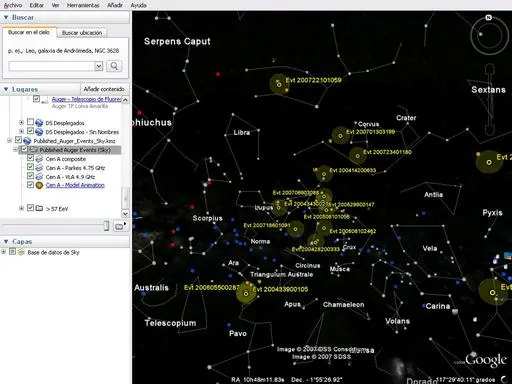
And it is also possible to have a view of the showers in Google Sky, by downloading the kmz file of published events.
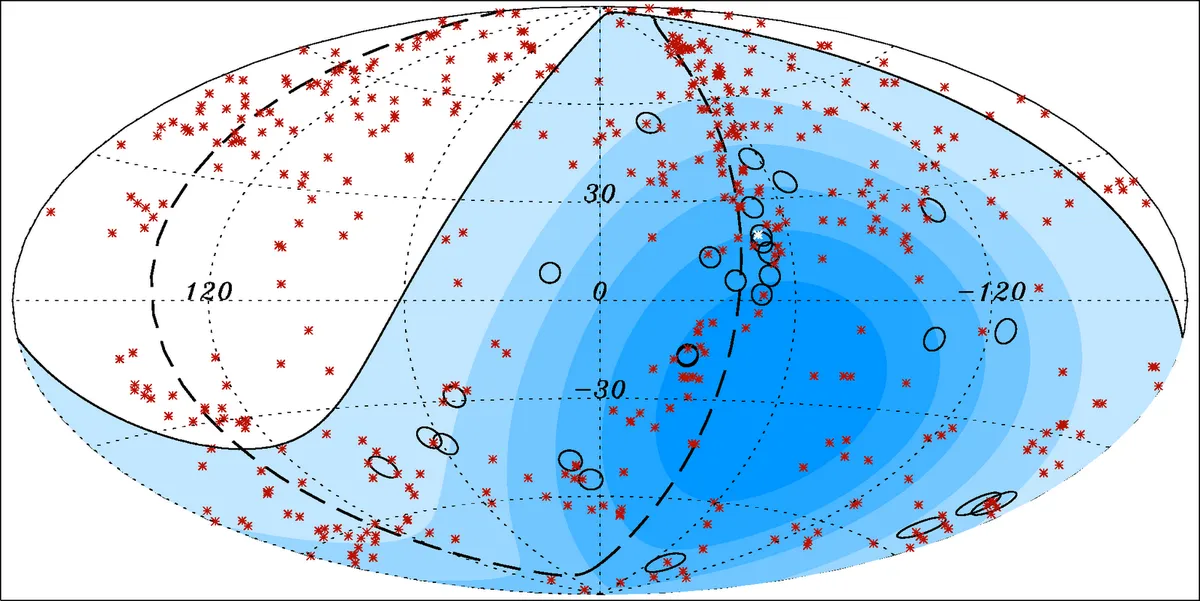
When opening this file we will access the Sky mode of the program to see nearby Active Galactic Nuclei (AGN), with a sun icon, which correlate with the arrivals of the events and could be the sources of the most energetic rays. The direction of Centaurus A, the AGN closest to Earth, is particularly interesting and the file allows visualizing an animation of it.
And there are more files, images and videos on Stephane Coutu's page.
Sources and related links
A cosmic challenge for the Auger Observatory
Ciencia Hoy, Volume 12 No.71. Page 49
Authors: Ingomar Alekotte - Diego Harari
The Greatest Energies in Nature, Alberto Etchegoyen - Alberto Filevich
Revista Ciencia Hoy, Volume 5. No. 35
About the images
Screenshots of Google Sky and Google Earth using Stephane Coutu's kmz files.
Argentine Pierre Auger Collaboration. Credit: Pierre Auger Observatory