Two stations of the ARA detector show encouraging results.
In Argentine popular literature, for example in the payadas, it is common to begin with the phrase "Aro, aro, arooo" which would mean "with permission"[1]. For example "Aro, aro, arooo. Yesterday I passed by your house, you threw a brick at me. Tomorrow I'll pass by again, I'll build myself a castle."
If the scientists of the ARA project used it they could say:
"Ara, Ara, Araaaa. Yesterday I passed by your house, you threw a neutrino at me. It went right through me!"
Neutrinos don't seem to stop for anything. Right now, 65 billion of these infinitesimal particles are passing through us, without harming us.
David Besson - from the University of Kansas - spokesperson for the ARA Neutrino Detector at the South Pole, precisely because of that, is optimistic.
"The fact that neutrinos are so penetrating makes them interesting in astrophysics. In the enormous stellar cataclysms that interest us, many particles are produced, but most will be absorbed by material in the interstellar medium before reaching us. In contrast, neutrinos, because they are so penetrating, can bring information from very far away, much more than a photon, for example", he explains.
"A neutrino produced in the center of the Sun might require a wall of lead one light-year thick to stop it, but you can block a photon with dark glasses", he exemplifies.
Why is it important to know more about neutrinos?
Well, because of Victor Hess, who a century ago discovered cosmic rays. What do cosmic rays have to do with neutrinos? Let's see.
THE THEORETICAL FRAMEWORK: GZK AND Azkaryan
In 1964 two Bell engineers discovered the cosmic microwave background radiation (CMB).
Two years later, the members of the Greisen–Zatsepin–Kuzmin trio pointed out that cosmic rays would have a limit: 5×10¹⁹ eV. Above that energy, cosmic rays would interact with the CMB within a distance of 150 million light-years. Such interaction would reduce the energy of the rays below the limit.
The Askaryan effect owes its name to the physicist Gurgen Askaryan, of Soviet-Armenian origin, who in 1962 studied the phenomenon by which a fast particle produces a shower of charged secondary particles and emits radiation (similar to the Cherenkov effect).
Energetic cosmic rays are called UHECR (ultrahigh-energy cosmic rays). When interacting with the CMB they lose energy, emitting pions that decay into neutrinos, according to GZK.[2] - [3]
The ARA detector
Based on this scientific foundation, a huge detector is being built at the South Pole, near IceCube, called the Askaryan Radio Array (ARA), which will be composed of 37 stations spaced 2 km apart. Each station will consist of 16 antennas buried 200 meters deep in the ice.
As neutrinos pass through the ice they emit radio waves that are recorded by these detectors.
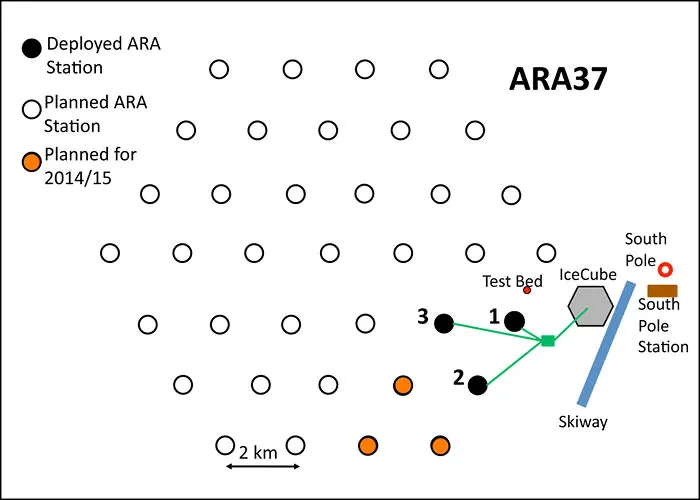
The ARA collaboration published in Physical Review D [4] the results of the first two stations indicating great potential and great radio "transparency" in the ice.
"Neutrinos tell us something about recent explosions in the history of the universe. But also, since they can come from great distances, they possess information about processes that occurred in the early universe. If you accumulate enough data from them, you can test theories of cosmic evolution", explains Besson.
So this is what it's about: Detecting unstoppable particles to understand the evolution of the enormous immensity of the unfathomable cosmos. No more, no less. Let's hope the neutrinos make "a stop along the way"...
https://youtu.be/nkydJXigkRE
(Video with Spanish subtitles)
Sources and related links
- [1] Aro
http://etimologias.dechile.net/?aro - [2] Greisen–Zatsepin–Kuzmin limit
https://en.wikipedia.org/wiki/Greisen%E2%80%93Zatsepin%E2%80%93Kuzmin_limit - [3] Askaryan effect on Wikipedia
https://en.wikipedia.org/wiki/Askaryan_effect - [4] Performance of two Askaryan Radio Array stations and first results in the search for ultrahigh energy neutrinos
P. Allison et al. (The ARA collaboration)
Phys. Rev. D 93, 082003 – Published 25 April 2016
DOI: 10.1103/PhysRevD.93.082003
http://dx.doi.org/10.1103/PhysRevD.93.082003 - arXiv:1507.08991 [astro-ph.HE]
http://arxiv.org/abs/1507.08991 - New detector at South Pole shows early success at neutrino hunting
https://news.ku.edu/2016/07/19/new-south-pole-detector-shows-early-success-neutrino-hunting - Askaryan Radio Array (ARA)
https://ara.wipac.wisc.edu/home
About the images
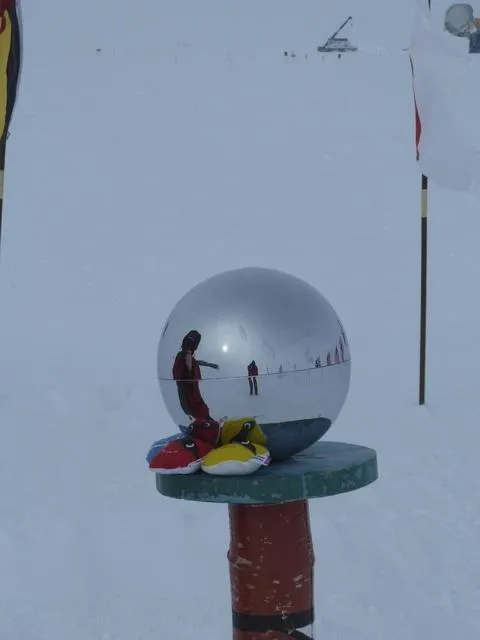
Initial image: from the ARA gallery: the South Pole marker, decorated with neutrino plush toys. Credit: ARA.
Map image: from the cited paper, ARA Collaboration.