Argentine Institute of Radio Astronomy (IAR)
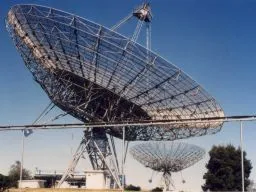
This Friday, December 1, the Argentine Institute of Radio Astronomy (IAR) celebrates its 40th anniversary. It does so at its original site, in Parque Iraola, Villa Elisa, where two enormous antennas are the hallmark of radio astronomy in the country, and a reference in
Latin America.
Via Boletín de Noticias Nro. 193 from the Observatorio Nacional de La Plata
They turned years old last March but the formal celebration will be this first Friday of December, starting at 11:00 and with the presence of the Institute's authorities, its staff, authorities from the Consejo Nacional de Investigaciones Científicas y Técnicas (CONICET) -on which it depends- from the Comisión Nacional de Asuntos Espaciales (CONAE), from the Universidad Nacional de La Plata and other related scientific institutes. Heavyweights in the scientific area like Carlos Varsavski, its founder, have woven the fabric of this site that makes radio astronomy a daily point of research and technological transfer.
The inauguration of the radio telescope in Parque Pereyra Iraola was on March 26, 1966. A few years earlier, efforts had begun for Argentina to have a radio telescope and a site for related research. This radio astronomy institute has many objectives achieved and yet to be realized; we spoke with Dr. Ricardo Morras, Director of the IAR.
-A new anniversary of the Argentine Institute of Radio Astronomy. Under what premises can so many years of research and radio astronomical observations be condensed?
This new anniversary, the fortieth, finds us taking stock, with successes and disappointments. Happy with the scientific production of the Institute (over 750 contributions); training of human resources (dozens of theses and dissertations in astronomy, physics, engineering and computer science); technological transfer (especially directed towards space activity); etc. Disappointments of not having been able to develop new strategic objectives, for example, a new instrument.
-What are the main topics, focal points, that the IAR will take on during this year?
We have begun discussing where we will direct our efforts: new instrument, search for astronomical sites of interest to install them, and continue with Technological Transfer, aiming at the training of new human resources.
-Having the largest radio astronomical telescope in South America. What commitment does it imply and how much is it required by countries that do not have such instrumental facilities?
That phrase contained in the question is a bit pompous: the IAR's radio telescopes have completed an important stage in their production, particularly with the conclusion of the large continuum radio surveys at 1420 MHz and the Neutral Hydrogen one. Although we have new observation projects, we are aware that these instruments can be valuable in the short/medium term. No longer. That is why we are discussing what new type of instrument the IAR needs for the next 10, 15 years.
-What do you believe, broadly speaking, is the perspective in radio astronomy, specifically in our country?
The IAR is investing efforts in characterizing the opacity of the atmosphere to find sites of radio astronomical interest. For example, it has an instrument operating at 4600 m altitude, in the heart of the Puna Salteña, 400 km west of the city of Salta. The development of radio astronomy is not separate from the country's development. The crises that afflicted Argentina in recent decades have left their marks on radio astronomy as well. Hence part of our frustrations that I mentioned at the beginning.
-What names stand out in the history of Argentine radio astronomy?
Carlos Varsavski (founder of the Institute), Esteban Bajaja and Wolfgang Poppel (both recently retired) who have contributed to the formation of the current replacement generation.
-What happens with the interest of young graduates?
At the IAR, around 30 young professionals and students from different areas (research and technology) have entered as fellows and interns, which makes us look at the future with deep optimism. They are the replacement generation.
A heart linked to the IAR
Esteban Bajaja, doctor in physics.
-You are very linked to the Argentine Institute of Radio Astronomy. Tell us a bit about that affiliation with the IAR.
I was born in 1931 and in that year radio astronomy was born, my affiliation with the Institute means having started working cleaning the land, laying cables, putting screws, building that antenna we still have there working and it was also 15 years in total of directing the IAR. I have spent a good part of my life trying to make the Institute continue functioning and I sincerely admire many people there who have spent many summers of forty degrees working in closed offices or with a lot of cold, so I am grateful not only for the opportunity to have worked in what I liked, but also to have the support of all these very valuable people.
Data about radio astronomy and radio telescopes
From the IAR, scientific research in Radio Astronomy is carried out, help and advice is provided to other institutions interested in this research, collaboration is made in the development of the teaching of the discipline, professionals and technicians are trained and dissemination of this specialty is made to society.
The instruments are fundamentally survey telescopes and have made their greatest contribution. In the medium term they will continue to produce databases of scientific importance, but the scientific utility will be limited by the structure of the antennas. If one does not wish to abandon the field of radio astronomical observation for scientific purposes, a new instrumental facility must be available.
Improvements to the existing instrumentation can be introduced in the short term; also develop an instrument based to a good degree on local experience and human resources, without ruling out links with the outside.
About the uses and characteristics of radio astronomy, we spoke with Dr. Marcelo Arnal, astronomer, researcher and professor at the Argentine Institute of Radio Astronomy and at the Facultad de Cs. Astronómicas y Geofísicas of the UNLP.
"There are many celestial objects that are not observable with optical instruments, for example, what we call the interstellar medium, which is a gas with very special properties where physical processes occur that are detected with radio telescopes regarding radio wavelengths and also processes captured in X-rays or in infrared happen.
From data collected with different telescopes, a complicated puzzle composed of the different frequencies taken into account can be assembled. "It's like seeing a human with the naked eye and then through an X-ray plate. They are other components of the same subject".
Arnal explained that Radioastronomy is a relatively young branch of astronomy that uses novel observation techniques and that, in many cases, is the only alternative available to investigate certain phenomena that occur in the universe. Through an arsenal of very varied instruments and observation techniques it has made important contributions in research fields as diverse as the study of the interstellar medium of galaxies, star formation, supernova remnants, pulsars, the dynamics of galaxies, the study of radio galaxies and quasars, cosmology, etc.
Regarding radio telescopes and their characteristics, Arnal pointed out that just as light prevents observation through an optical telescope, radio telescopes are affected by the presence of a nearby radio or television station, cellular phone communications, the Ezeiza radar, or artificial satellites that download information or to which information is transmitted from Earth. 'All of that is noise for us and the techniques to eliminate it lead to very important technological development that is then also applied to telecommunications, to the recognition of natural resources in satellite images, etc.'
Rain is not a problem for using a radio telescope, but electrical storms or very intense winds are, since the antenna like the one we have at the IAR is 30 meters in diameter and a strong wind could dislodge it from its anchorage.
The radio telescope located at the Instituto Argentino de Radioastronomía is the only one that exists in our country and the only one of its kind in all of Latin America. The instruments are fundamentally 'survey' telescopes and have made their greatest contribution. In the medium term they will continue to produce databases of scientific importance, but the scientific utility will be limited by the structure of the antennas. If one does not wish to abandon the field of radio astronomical observation for scientific purposes, a new instrumental facility will be needed.
'The importance of radioastronomy within the context of astronomy in general,' adds Arnal, 'can be seen in the 126 radio telescopes existing in the world out of the 456 telescopes that exist in 36 countries.'
The Grupo de Astrofísica Relativista y Radioastronomía (G.A.R.R.A) operates at the IAR, dealing with basic topics of relativistic astrophysics, including cosmic rays, black holes, microquasars, and active galactic nuclei.
From the IAR, scientific research in Radioastronomy is carried out, help and advice is provided to other institutions interested in this research, collaboration is made in the development of the teaching of the discipline, professionals and technicians are trained, and dissemination of this specialty to society is done.
Source: interviews conducted by Per. Alejandra Sofía
News Bulletin of the Observatorio Astronómico de la UNLP
-----------------------------------------------
Origins of Radioastronomy (*)
An engineer from Bell Telephone Laboratories, Karl Jansky, studying the nature of the noises that disturbed communications on short waves, and working with a directional antenna and a receiver for l=14.6 meters, discovered in 1932 an intense source of noise in a specific area of the sky. From the systematic study of it he noted that the signal, with the same antenna position, repeated approximately every 23h 56m.
The source of noise had to be external to the solar system, since that period corresponds precisely to the sidereal day (23h 56m 04s). Jansky had observed the center of our galaxy, thus performing the first radio astronomical observation and establishing the basis for a new way to study the universe.
However, this discovery was not considered important for the company where Jansky worked, although it was for the engineer and radio amateur Grote Reber who, years later (1940), built at his home the first antenna dedicated to astronomical purposes with a parabolic reflector, thus introducing the design that would subsequently be adopted, basically, by all radio observatories.
With that parabolic antenna of 9.6 meters in diameter and a receiver for 160 MHz (l=1.87 meters) he was able to trace the first radio map of the sky. Subsequently, with the progressive development of technology, the resolving power of the antennas and the sensitivity of the receivers were improved, and gradually the interest of astronomers turned towards this new way of observing the cosmos.
(*) Taken from the IAR page
The IAR is located at km 40 of Camino Gral. Belgrano, inside the Parque Pereyra Iraola.
Camino Gral. Belgrano km 40 - Berazategui
Prov. de Buenos Aires - ARGENTINA
Tel: +54-221-482-4903 Tel/Fax: +54-221-425-4909