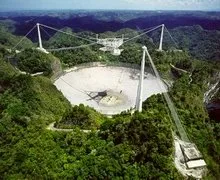
The Arecibo radio telescope, the largest of its kind in the world, which for four decades has been listening to the most remote confines of the universe, tracking asteroids, discovering planets, and sending extraterrestrial messages, could cease operations in five years due to lack of funds.
Via La Hora
A panel from the U.S. National Science Foundation (NSF), owner of the observatory, recommended in early November cutting the center's budget by 25%, from 10.5 million to eight million dollars annually, and its eventual closure if additional funding sources are not secured by 2011.
One of the most concerning consequences is the potential closure of the observatory's planetary radar, the most precise instrument for examining in detail asteroids with remote—though real—probabilities of causing an apocalyptic catastrophe on the planet.
In a letter to the NSF, Guy Consolmagno, Director of Planetary Sciences at the American Astronomical Society and a member of the Vatican Observatory, warned that the closure "would represent a hard blow both to our science and to our security."
"These radar measurements are the only way to obtain information" about asteroids, said Consolmagno. Once an asteroid is discovered by an optical telescope, "the radar allows us to make detailed models of its shape, the only way we can calculate the volume of these bodies," explained the scientist.
Inaugurated in 1963 in the mountains of the city of Arecibo, in the north of the Caribbean island of Puerto Rico, the radio telescope is a huge dish-shaped antenna 305 meters in diameter, with a receiver suspended 137 meters high on a mobile platform weighing 900 tons.
The machine receives radio signals from celestial bodies and the receiver processes and scrutinizes them or maps parts of the universe inaccessible to optical telescopes.
It has been the source of important scientific discoveries: the first planets outside the Solar System (1992), the first direct images of an asteroid (1989), or observations of pulsars (neutron stars) that led to confirming Einstein's Theory of Relativity, which was recognized with two Nobel Prizes in Physics (1993).
But more mundane reasons have earned the place fame, where sequences from the James Bond film "Goldeneye," from "The X-Files," and from "Contact," with Jodie Foster, based on the novel by Carl Sagan that revolves around the most popular experiment carried out with the Arecibo antenna: SETI, the search for an extraterrestrial signal of artificial origin.
The story, however, could come to an end in five years if funding outside the government is not found. The cuts include all U.S. national observatories.
"The federal budget is not in good shape, it is very difficult to obtain discretionary funds," said Joseph Burns, deputy director of Physical Sciences and Engineering at Cornell University (New York), which administers the observatory.
Burns clarified, however, that the recommendations are not final, and that probably nothing will be done until more members of the scientific community are heard.
The closure would affect about 150 employees, more than 200 scientists, and about one hundred thousand tourists and students who visit it annually.
According to José Alonso, director of the observatory's Visitor Center, it would also leave the planet nearsighted in the face of the asteroid threat. The only observatory that could potentially replace Arecibo is the international effort "Square Kilometer Array," whose construction would begin in 2011 and end in 2020, in Australia or South Africa.
"We can measure the orbit of an asteroid with great precision and predict whether in a thousand years, 500 thousand years, or whatever, it would collide with Earth," said Alonso.
"About one hundred asteroids that pass very close to Earth have been identified, and there is no other telescope in the world that can do that tracking," affirmed Alonso.
"It is inevitable that (an asteroid) will hit us, the main question is when," added Burns.
Although the possibility of colliding with an asteroid seems remote, one need not look far to find precedents: it is believed that one fell on Yucatán 65 million years ago, possibly causing the extinction of the dinosaurs.
Scientists have also forecasted asteroid approaches in 2102 and 2880.
Observatory page:http://www.naic.edu/