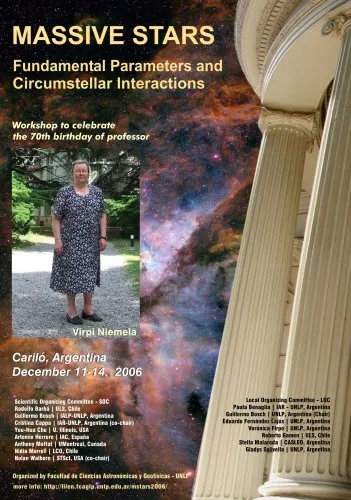
During the week of December 11 to 14, on Cariló beach, astronomers from various parts of the world will gather to share work and debates about massive stars.
Via Boletín de noticias del Observatorio Nacional de La Plata
This meeting celebrates the 70th birthday of Dr. Virpi Niemela, an astronomer and researcher at the Facultad de Ciencias Astronómicas y Geofísicas, with a distinguished career whose specialty is the reason for the upcoming gathering.
Among the many topics related to massive stars, this Workshop will emphasize their fundamental parameters and the interaction with their circumstellar materials.
From the Massive Stars Group of that institution, they explain that the light emitted by a star is produced by nuclear reactions in its interior. The development of these reactions depends mainly on the star's mass. The more massive it is, the more light it emits, but it also uses up its nuclear fuel faster, and therefore lives a shorter time.
Stars also emit a flow of matter, called stellar wind. When there are two massive stars close to each other, the collision of their winds produces X-rays. The winds of massive stars are very powerful, with speeds of thousands of km/sec, sweeping the surrounding medium. These strong winds over time "strip" the surface layers of massive stars, which at the end of their lives show on their surface the products of nuclear fusion.
The researchers of this Group study massive stars by analyzing their spectra, obtaining images of their "habitats" in different bands of the electromagnetic spectrum of light, studying the movements of two stars orbiting one another, from which stellar mass values can be deduced. Massive stars also emit X-rays, especially when they form groups of two or more.
More information at:
http://lilen.fcaglp.unlp.edu.ar/mstars2006/index2.html