Dr. Gustavo E. Romero has multiple activities interwoven in the fabric of Astronomy: he is part of the GARRA group (Grupo de Astrofísica Relativista y Radioastronomía) of the Instituto Argentino de Radioastronomía (IAR); he is a professor of Relativistic Astrophysics at the Facultad de Cs. Astronómicas y Geofísicas of the UNLP and, among other things, he supervises several thesis students. His work deals with both theory and observation -in radio, optical, X-ray and gamma- with the fascinating "world" of black holes; how gamma rays are produced; blazars -very variable extragalactic light sources-, microquasars, high-energy physics -in particular the elementary components of matter- and the interactions between them, etc. Dr. Romero added to his agenda the study of ultra-energetic processes related to massive stars. And on this point he expanded in the recent International meeting on massive stars, held in Cariló.
By Alejandra Sofía
Via Observatorio de la Universidad de La Plata
Dr. Gustavo E. Romero has multiple activities interwoven in the fabric of Astronomy: he is part of the GARRA group (Grupo de Astrofísica Relativista y Radioastronomía) of the Instituto Argentino de Radioastronomía (IAR); he is a professor of Relativistic Astrophysics at the Facultad de Cs. Astronómicas y Geofísicas of the UNLP and, among other things, he supervises several thesis students. His work deals with both theory and observation -in radio, optical, X-ray and gamma- with the fascinating "world" of black holes; how gamma rays are produced; blazars -very variable extragalactic light sources-, microquasars, high-energy physics -in particular the elementary components of matter- and the interactions between them, etc. Dr. Romero added to his agenda the study of ultra-energetic processes related to massive stars. And on this point he expanded in the recent International meeting on massive stars, held in Cariló.
Images at:
http://www.fcaglp.unlp.edu.ar/~extension/197/
-What work did you present at that meeting?
I presented an invited review lecture, where I reviewed what is known to date about the interaction of microquasars with massive stars. A microquasar is a binary system formed by a compact object, which can be a neutron star or a black hole and a normal companion star, which can be a massive star or not, like, for example, the Sun.
In that lecture we concentrated on microquasars where the companion star is a massive one (a black hole + a massive star or a neutron star + a "massive" one). We studied the interaction of the jet of relativistic particles -particles that move at speeds of light or very close to it- ejected from the vicinity of the compact object with everything produced by the massive star: the light, the stellar wind, etc. This interaction produces gamma rays, neutrinos, a very rich phenomenology that can only now be studied.
-Are microquasars common in galaxies, how are they observed?
About 15 are known in our galaxy, although there are undoubtedly more, perhaps several hundred. The topic of the interaction of the "jet" with the radiative fields and the wind of the star is a new topic, which is just beginning to be explored. As they are very energetic interactions, the observations and predictions fall largely within the range of gamma astronomy (very energetic radiation produced in violent astrophysical phenomena due to the high energies they possess) and neutrino astronomy, areas in which I work. The instruments used to measure this emission are Cherenkov telescopes and satellites with orbital gamma observatories.
-When did the work begin and which object or objects did you put in your "sights"?
I started working on the topic in the late '90s. Until now the most complete models for these things have been published within my group or in collaborations of the group with other researchers from abroad. Among the main achievements is the prediction of gamma rays with energies of TeVs (a measure of energy: Tera electron volt) in the microquasar LS I +61 303
(discovered this year by MAGIC, a gamma telescope in the Canary Islands, the largest in the world), the development of the first hadronic models for these sources, and the calculation of realistic models for microquasar jets, taking into account all relevant processes.
-Hadronic models?
Electromagnetic radiation in the gamma-ray range can be produced by the interaction of atomic nuclei -particles that are made of quarks- such as protons or neutrons; it is not the case for electrons which do not have quarks (electrons are leptons, not hadrons).
The way they produce electromagnetic radiation is totally different from the way an electron can produce it. Historical models for microquasars are always with electrons and we for the first time introduced models with hadrons, to produce gamma rays in these sources. These models, in addition to gamma rays, predict neutrinos, which is a new and additional prediction in this topic.
-Tell us about the "novelties" that the work yields and if you had indications that you would achieve the results obtained.
Well, I presented many results, because it was a review talk. The most important novelties are that we now know that microquasars, in fact, emit gamma rays. Although we have been predicting it for years, it has only been confirmed in the last 12 months, with respective articles published in "Nature" and "Science"; in the latter I was a co-author.
-How "new" is the topic in the universe of massive stars?
It is absolutely new. Many of the participants heard about this for the first time there. It has potential for people working on massive stars, since the "jets" can be used to "probe" the winds of the stars through the products of the interactions. Also, microquasars formed with massive stars, there are only six known in the Milky Way. The Meeting has been very fruitful, possible joint works with other researchers on massive stars and high energies have emerged. It is a very interesting feedback.
How does the topic continue?
The topic continues with the development of even more realistic models. For example, my doctoral student Mariana Orellana works on the calculation of electromagnetic cascades and we will also continue with the testing of the new predictions with new generation telescopes like GLAST, MAGIC II and HESS II.
-The electromagnetic cascade thing, can you clarify it?
With that term we refer to an avalanche process: stars produce a lot of light, they are very luminous. If a gamma ray is introduced into that environment, it will interact with a photon from the star. That will produce an electron-positron pair, and that pair in turn will interact with photons from the star and the process repeats. From a single particle, you end up with hundreds, thousands, millions of particles: this is the cascade.
Is that effect visible?
You see the radiation produced by the particles, which is not the same as the radiation produced by the source itself; it is radiation reprocessed by those cascades. It is a phenomenon that only occurs in the vicinity of the star.
------------------------------------------------------------------------
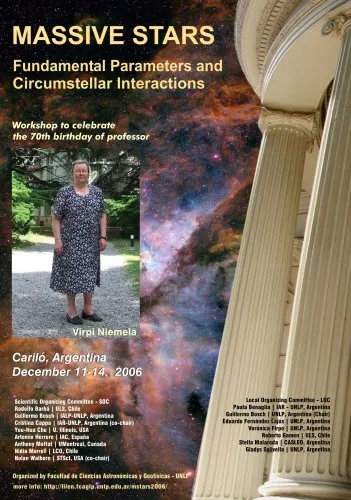
The talk concludes with a reference to Dr. Virpi Niemela, a specialist in the topic of massive stars who passed away a few days ago.
"I was never a student of Virpi's nor did I have the luck to take a course with her. However, I have always been aware of her work through Paula (Benaglia), who works on massive stars. What impressed me most about Virpi is her enormous effort to ensure that women could work with equal opportunities in this science. If you think of the great names of Argentine astronomy, from Gould, Hartmann, Gaviola, Sahade, etc., we see that until Virpi, women did not hold positions of influence. Now that has completely changed. I believe Argentina must be one of the countries with the most women astronomers. Of my doctoral students, 3 out of 4 are women. This, to a large extent, we owe to her. This year, among the many tributes she received, she was named an Honorary Member of the Asociación Argentina de Astronomía, on the initiative of the Board of Directors. I believe she had the luck to see the recognition of the entire astronomical community."
More information about the GARRA Group and Dr. Gustavo Romero at:
http://www.iar.unlp.edu.ar/garra/
Images at:
http://www.fcaglp.unlp.edu.ar/~extension/197/