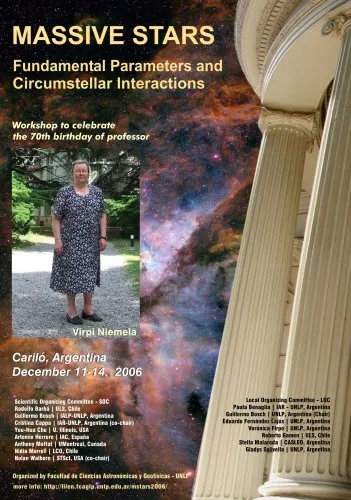
It's not really that stars can decide their fate, but they do achieve many of their own characteristics according to their mass, temperature, and other factors. Dr. Paula Benaglia is an astronomer and, together with colleagues from various parts of the world, she advanced the observation in radio waves of a phenomenon until now only predicted by theory: some stars lose a lot of mass and others do so in a "normal" way according to astronomical guidelines.
By Alejandra Sofía from the National Observatory of La Plata
We look at the stars until we are ecstatic, sometimes city lights leave us somewhat orphaned of them, but we still raise our gaze to "hang on" to their twinkling. Astronomers also observe them and although they do it in this same way, they add observations to limits that are hard to comprehend. They are detailed studies, analyses of their brightness behaviors, how hot they are, what happens with the winds around them, the exchanges of material with companion stars... And among so much detail, a group of theoretical and observational astronomers is unveiling an effect called bistability.
Paula Benaglia presented a work on that topic at the Massive Stars Meeting, held in mid-December.
Images at:
http://www.fcaglp.unlp.edu.ar/~extension/197/
-Paula, what is this about bistability, the core of your talk at the last massive stars meeting?
In this last year I have been working with a group of people from different places, mainly with a Dutch astronomer (currently working in Ireland) and others from Spain, Australia, and England. I presented an oral work done with them in which we tried, from observations in radio waves, to prove an effect that Jorick Vink, a Dutch astronomer, working together with compatriots, had predicted in theory.
It is about an effect actually called "bistability jump in the mass-loss rate", which appears in massive O and B stars (very hot stars). When one selects stars with lower and lower surface temperature, around 21000 Kelvin, the rate at which these stars lose mass (or mass-loss rate) suffers an increase instead of continuing to decrease, as happens in very hot or hot stars. The stars can be on one side or the other of this effect, they can have a normal or an increased mass loss. They behave in one way but not in both ways at once.
-What does this higher or lower speed of losing their mass depend on?
On many things, like the speed of the stellar wind, temperature, chemical composition, the ionization state of the gas that forms the winds, density. But more than anything, on the temperature of the wind and, according to theory, what seems to determine that loss is the amount of iron in an ionized state present in the star's wind.
-These stars lose more mass than expected
The Sun loses mass at a rate equivalent to 1 solar mass every 100 trillion years: its mass-loss rate is 10 to the (-14) solar masses per year. In the stars we study, the loss rate is about 9 orders of magnitude greater: the equivalent of 1 solar mass every 100 thousand years (10 to the -5 solar masses per year). These stars live a few million years, and have masses between 10 and 80 solar masses. They can lose up to about half of their mass due to the action of their winds, before exploding as supernovae.
-Where did you do the radio observations?
There were important works of radio wave observations towards these stars, consisting of their detection, measurement of the emission intensity, and studies of the variation of this intensity with the observation frequency.
However, the studies were done by different groups, and each group used different sets of stellar parameters to derive variables like the mass-loss rate. This meant the final results could not be comparable with each other.
Our work consisted, on one hand, in carrying out new observations towards 12 stars. To this we added the compilation of previous observations of 18 objects, and we treated the complete sample in a homogeneous way, adopting for the stars in it a uniform set of stellar parameters.
In this way we re-calculated all the mass-loss rates.
The new observations were made using two interferometers: One in Australia and one in the United States. From the intensity measured at radio frequencies we could determine the average value of mass loss, how fast -in terms of years- these stars lose mass. The radio emission from these stellar winds is very weak and of little extent (less than arcseconds), so to detect them one must use very sensitive instruments with high magnification.
The chosen stars are from our galaxy: radio stars can only be detected up to a few kiloparsecs. Basically, there are three ways to calculate the mass-loss rate: based on optical data, in ultraviolet, and in radio. We observe in radio the amount of flux, a measure of the energy we receive from the star's luminosity. It is interesting to compare the mass-loss values obtained by the three methods: when observing in radio waves one gets information about what happens to the stellar wind in the outermost part. In the optical, data from its innermost part is obtained, which can behave differently from the outer part. In the ultraviolet, the information that arrives comes from the entire star's wind. In this way, the methods serve to "sample" the different parts of the wind, and from the comparison of the results the state of homogeneity of the wind can be deduced.
The radio wave method for deriving the stellar mass-loss rate is considered the most precise, as it involves the fewest assumptions (or modeling of the physical parameters of the wind) in the calculations.
Conclusion?
On one hand, in the stars observed in radio we found that the evidence so far is not conclusive regarding whether this type of effect exists, but there are indications. Around the temperatures of this bistability "jump" we had 4 stars of which 2 showed normal behavior. In the other two, the mass-loss rate "jumped" to values up to 3 times greater. The other 26 stars in the sample are on both sides of the jump.
We have to keep observing new stars in radio because there are no more examples. It is difficult to detect them, due to their low radio luminosity, so we will have to be patient and observe each object for longer. Our work had a good impact in the astronomical community; we know there are few examples, but the effect predicted by theory is not in contradiction with our results.
-Observations continue
We have to request observing time on the "Very Large Array (VLA)" radio telescope located in Socorro, United States, before February 1; it's 27 antennas -the ones that appear in the movie "Contact"- and we have already observed and will continue to do so with instruments in Australia.
There we use the "Australia Telescope Compact Array" (ATCA), composed of six radio telescopes working as an array and located at the Paul Wild Observatory in Narrabri, New South Wales. The Australians also have the 64-meter diameter "Parkes" radio telescope and a very long baseline interferometer system, across all of Australia, formed by ATCA and seven more antennas. The "VLA" covers the northern sky and part of the southern, and the "ATCA" the southern sky.
-------------------------
Paula Benaglia began researching interstellar material (the topic of her thesis), went to work at the VLA for a year, to collect data. Then she focused on interstellar bubbles. Since 1998, work on massive stars emerged, a topic to which she dedicates most of her scientific time. "I contacted a German colleague (Baerbel Koribalski), who lives in Australia, and we started observing massive stars, we usually take turns. We also exchange information and do work with Gustavo (Romero) when we want to relate radio emission with high-energy emission. Because the winds of those stars can sometimes accelerate particles to relativistic energies, that is, close to the speed of light."
Dr. Benaglia is part of the GARRA Group and is also a professor at the Faculty of Astronomical and Geophysical Sciences of the UNLP. Among the collaborative projects is one with the group of Dr. Virpi Niemela (led by Virpi herself) which aims to discover massive binary companions of OB stars that show non-thermal radio emission (typical of colliding wind regions).
More information at: http://www.iar.unlp.edu.ar/garra/garra-pb.html
Images at:
http://www.fcaglp.unlp.edu.ar/~extension/197/
-----------
Related data, on wikipedia:
Estrella de Wolf-Rayet