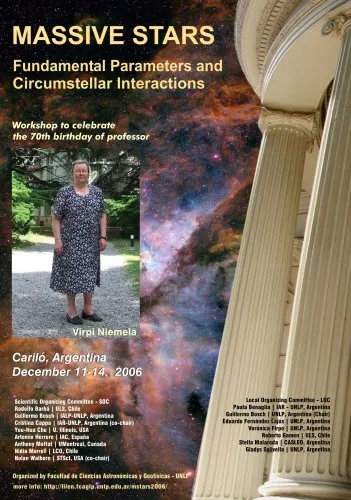
December brought together a large group of researchers linked to a specific area within astronomical science: massive stars. The beaches of Cariló provided a special setting for this meeting (see previous note on the subject), and it was also special for being dedicated to a pioneer in this field, Dr. Virpi Niemela.
From the latest issue of the Boletín de noticias del Observatorio Astronómico de La Plata, Alejandra Sofía brings us an interview about massive stars with Dr. Stan Owocki.
For 20 years, Stan Owocki has developed his professional activity in the physics and astronomy department of the University of Delaware, United States. When he learned about this Meeting, he did not hesitate to participate and did so by presenting work related to the magnetic field around massive stars.
In very good spirits and patient when repeating a word not understood due to language issues, Dr. Owocki talked about his professional activity and knew how to convey the passion that envelops him when trying to advance the understanding of some aspects of the universe.
"When I began my professional career I dedicated myself to studying the Sun, particularly the solar wind, that matter that is expelled from our star; I obtained my first post-doctorate in astrophysics at the Harvard-Smithsonian Institute and became interested in the winds of massive stars. These stars are intrinsically very bright, sometimes a million times brighter than our Sun. In the 1980s I began to investigate how the process of stellar winds works in these stars and I am still doing it. In more recent years a topic that interested me is related to a few cases -more or less 10%- within this type of stars: we have reasons to believe that some have a very strong magnetic field; at the Cariló meeting I talked about what happens when the star tries to expel matter and the magnetic field stops it."
Dr. Owocki is a theoretical astronomer and creates models of this type of stellar circumstances. As is usual in this science, he relies on observations made by colleagues, through optical telescopes, in gamma rays, X-rays and in infrared.
"Another topic that interests me a lot is trying to understand characteristics of these stars, one can ask what is the minimum and maximum mass they can have; we are talking about a maximum of 150 solar masses. Currently, researchers, using the new telescopes, can see thousands of massive stars and analyze the distribution according to their brightness; their brightness is very related to their masses. Mass and luminosity go together. But stars of more than 150 solar masses have not yet been seen, a limit already identified in the 1920s by Arthur Eddington."
"For a few years now, there have been speculations indicating that one of the first objects formed in the universe would be massive stars. We try to connect that initial universe with the current one. And it is very fascinating to feel that the work we do on massive stars is important in the context of the evolution of the universe, and it is not just a specific topic like so many others in astronomy. This has been heard in many of the talks at this Meeting."
Stan Owocki is very precise when arguing his choice of research topics: "I don't like to choose something because it's fashionable, I like to take time to understand the topics I choose, I do astrophysics in a calm way; it happens that now they are topics that have become fashionable but that was not the reason for my choice."
"I always tell young people to follow what they feel is interesting, what generates passion in them and to do good science. If they do, surely their work will be relevant, because science is like a network job, everything is connected and by doing good science they will help other areas. We have very little lifetime and we make only a small contribution to try to understand the universe. Every morning I get up and tell myself what a great privilege it is that I get paid to do what I like so much, how fortunate I am."
"I work with three people who are doing their post-doctorate and with four graduates; I really like teaching and it is a help for one of the problems of the scientist who must focus on a topic to progress and sometimes we lose perspective of what is around; by teaching, you permanently make that connection. When a student tells me: you have changed my life... it is very gratifying!"
Dr. Owocki comments that upon his return he will share with his group the news that arose at the Meeting and promises himself to obtain resources so that some of his students can attend future meetings.
"When you read a paper by someone you don't know it's different from when you have dealt with them, personal contact is very important in science."
Finally, this professor points out that "those of us who work on massive stars have a lot of respect for each other and there is no such thing as destroying or humiliating the other; it is very good to be relaxed and able to share ideas more freely. One knows and feels that they are not going to use the ideas against you but in a constructive way. And that is another reason why I like to work in this area."
Images at:
http://www.fcaglp.unlp.edu.ar/~extension/203/entrevista/
-----------------------------
At the Facultad de Cs. Astronómicas y Geofísicas there is a massive stars research group and they explain this on their website:
The light emitted by a star is produced by nuclear reactions in its interior. The development of these reactions depends mainly on the mass of the star. The more massive it is, the more light it emits, but it also uses up its nuclear fuel faster, and therefore lives a shorter time.
Stars also emit a flow of matter, called stellar wind. When there are two massive stars close to each other, the collision of their winds produces X-rays. The winds of massive stars are very powerful, they have speeds of thousands of km/sec, sweeping the surrounding medium. These strong winds over time 'strip' the outer layers of massive stars, which at the end of their life show on their surface the products of nuclear fusion.
Our group studies massive stars: analyzing their spectra, obtaining images of their habitats in different bands of the electromagnetic spectrum of light, studying the movements of two stars orbiting each other, from which stellar mass values can be deduced.
http://lilen.fcaglp.unlp.edu.ar/index.html
On his page, Owocki has links to photo galleries. Here is a gallery of photographs taken during his visit to Cariló and Buenos Aires.