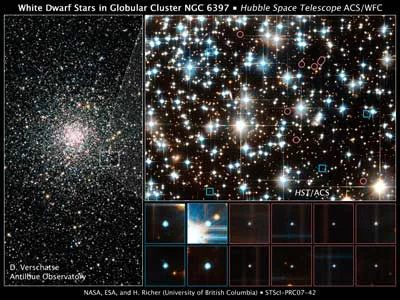
Astronomers from the Harvard-Smithsonian Center for Astrophysics found that a supernova discovered last year was caused by the collision of two white dwarfs. The dwarfs were siblings orbiting each other. They slowly approached each other until merging in a titanic explosion.
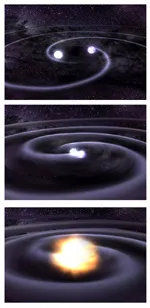
Illustration. NASA/Dana Berry, Sky Works Digital
The observations are the strongest evidence so far for a mechanism that was purely theoretical for the creation of a supernova.
"These discoveries show that nature can be richer than we suspected, with more than one way to make a white dwarf explode," says the author of the paper Malcolm Hicken, which is published in the November 1st edition of The Astrophysical Journal Letters.
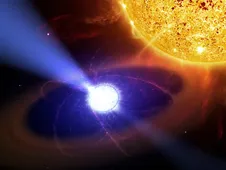
Astronomers characterize a supernova based on whether its spectrum shows evidence of hydrogen (Type II) or not (Type I). In Type II, a massive star collapses its core and explodes. In the conventional picture for Type Ia, the most common, a white dwarf collects gas from a companion until a catastrophic nuclear fusion occurs and it explodes. The recently discovered supernova 2006gz showed the strong spectral signature of carbon. Merging white dwarfs are expected to have carbon outside their densest regions. The powerful explosion from within would have sent the carbon-rich layers outward.
The spectrum of 2006gz also showed evidence of compressed silicon layers. The silicon was created during the explosion and then compressed by a shock wave that bounced off the carbon and oxygen layers. Computer models for white dwarf mergers predict both spectral signatures, of carbon and silicon.
Additionally, the supernova was brighter than expected, indicating that its progenitor exceeded the Chandrasekhar limit of 1.4 solar masses. Only one other potential example of a super-Chandrasekhar supernova has been seen: SN 2003fg, but the observations of that event were not as strong as in this other case.
Additionally, SN 2006gz has cosmological implications. Type Ia supernovae are used as "standard candles" due to their brightness, for cosmic distance calculations. If this type of supernova is more varied than thought, astronomers will have to be more cautious when using them to study the cosmos.
Sources and related links
Press release at Cfa