Brown dwarf stars, objects less massive than stars but larger than planets, appear to be more elusive, according to a study of 233 nearby multi-star systems by Hubble.
Scientists found only two brown dwarfs as companions to normal stars. This means that the so-called "brown dwarf desert" (the absence of this type of object around stars like the Sun) extends to smaller stars in the universe.
Sergio Dieterich of Georgia State University in Atlanta and team leader is reporting the results at the 213th Annual Meeting of the American Astronomical Society (AAS) in Long Beach, California.
"We continue to not find brown dwarfs around small red stars whose mass is only a little above the hydrogen burning limit. Especially when we consider the fact that binary brown dwarfs exist, the fact that there are very few binaries whose component lies on different sides of the hydrogen limit is significant," says Dieterich.
The 233 stars studied are part of the RECONS survey whose goal is to understand the nature of the Sun's neighborhood. The current primary goal is to discover and characterize the "lost" or missing members of the sample of stars within 32.6 light-years (10 parsecs) of Earth.
RECONS searches for nearby stars through the analysis of all-sky surveys, combined with observations from a variety of telescopes in both hemispheres. A total of 12 brown dwarfs are known within 10 parsecs, compared to 239 red dwarf stars (stars that have 20% of the mass of our Sun and almost half the diameter and temperature).
In fact, the number of known brown dwarfs is close to the known exoplanets. However, the number of known exoplanets in this region so far is, very likely, a lower limit since lower-mass exoplanets are difficult to detect currently.
The Hubble survey provides strong statistical evidence pointing to the fact that brown dwarfs do not exist around the least massive stars. The results are complementary to another study, also reported at the AAS, by Micaela Stumpf of the Max Planck Institute. The results imply that brown dwarfs tend to "socialize" with their own kind.
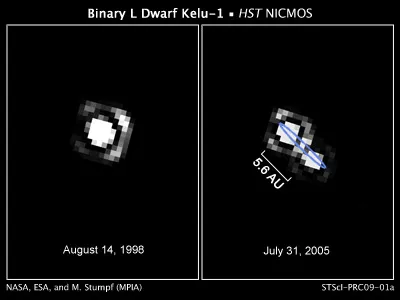
This other study reports new data on the double brown dwarf system Kelu-1AB, also indicating the possibility of a third member, which would make it the first triple brown dwarf system discovered.
This pair of Hubble images of the brown binary Kelu-1 tracks the orbital motion of two stars, with seven years difference. In 1998, the stars were too close to be observed individually. In 2005, they separated a bit. (520 million miles). The brown dwarfs are 61 and 50 times the mass of Jupiter, so they are too small to become stars (the Sun is about 1000 times larger than Jupiter), but too large to be planets. Astronomers suspect the existence of a third member, not yet detected.
Sources and related links
- Brown Dwarfs Don't Hang Out With Stars
- Final Results From an HST/NICMOS Search for Close Companions to Nearby Stars
Sergio Dieterich
213 AAS Meeting - A High Resolution Study of the Physical Properties of Brown Dwarfs and the Search for Planetary Mass Companions
Micaela B. Stumpf
213 AAS Meeting
About the images
Credit: NASA, ESA, and M. Stumpf (Max-Planck-Institute for Astronomy)