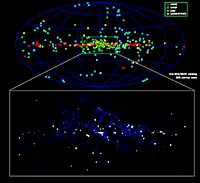
With more than 70% of the sky already observed by Integral, astronomers have been able to build the largest catalog of objects emitting gamma rays.
Via ESA
Integral is ESA's orbital gamma-ray observatory. Since the start of its scientific operations in 2003, the project team has dedicated a substantial proportion of time to studying the gamma rays of the universe.
A European team of astronomers, led by Antony Bird of the University of Southampton in England, has transformed three years of collected data into a catalog of gamma-ray sources. It contains a total of 421 objects, most cataloged either as binary stars in our galaxy containing exotic objects like black holes and neutron stars, or as distant active galaxies. However, a quarter of the objects remain unidentified.
It is thought that many of these objects would be star systems shrouded in dust and gas or variable stars.
Since the study goes far beyond our galaxy, the number of active galactic nuclei seen has increased, which, according to the project scientists, are concentrated in the same place as ordinary galaxies. This is not an unexpected result but it is the first time a distribution of AGN has been seen at these high energies.
Just as the Einstein observatory produced the X-ray catalog that ended up being a standard reference for those objects, Integral is doing the same with gamma rays.