Phantasmagorical galaxies composed almost entirely of dark matter speckle the universe. Unlike normal galaxies, these extreme systems contain very few stars and are almost devoid of gas.
Via EurekAlert
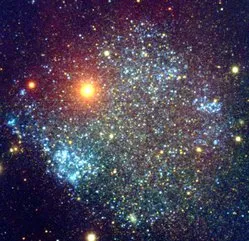
Most of the luminous matter, so common in the rest of the galaxies, has been stripped away leaving only a shadow of dark matter. These intriguing galaxies known as dwarf spheroidal galaxies, are so faint, that although researchers think they exist, only those relatively close to Earth have been observed. And until very recently, no proposed scientific model to unveil their origin could simultaneously explain their exceptional dark matter content and their inclination to exist only in the vicinity of much larger galaxies.
Now, Stelios Kazantzidis, a researcher at Stanford University, of the Kavli Institute for Particle Astrophysics and Cosmology (KIPAC), in collaboration with Lucio Mayer of the Swiss Federal Institute of Technology in Zurich, Chiara Mastropietro of the University of Munich in Germany and James Wadley of McMaster University in Canada have developed an elegant explanation of how galaxies are dominated by dark matter. Kazantzidis reports his findings in the February 15 edition of Nature.
Using supercomputers to create simulations of galaxy formation, the scientist and his collaborators found that a dark matter-dominated galaxy begins its life as a normal system. But when it approaches a much more massive galaxy, it simultaneously encounters three effects: "ram pressure", "tidal shocking" and the cosmic ultraviolet background that transform it into a mere shadow of its original formation.
10 billion years ago, when the gas-rich progenitors of dark matter-dominated galaxies originally fell into the Milky Way, the universe was heated by radiation from the cosmic ultraviolet background. As a small satellite galaxy traveled along its elliptical path around a massive galaxy, called the host, this radiation heated the gas of the smaller galaxy. This state allowed the instance called "ram pressure", a kind of wind resistance that the galaxy receives and strips gas from the satellite galaxy.
Simultaneously, as the smaller galaxy moves closer to the massive system, it encounters the gravitational pull of the host galaxy. Over billions of years of evolution, the satellite passes by the massive one many times. Each time, the satellite loses stars to the gravitational pull or "tidal shocking". These effects then conspired to strip gas and stars from the galaxy leaving only the dark matter.
This matter, on the other hand, was non-gaseous, therefore it was not affected by the force of the pressure or the cosmic ultraviolet background. It did experience the gravitational pull, but this force alone was not enough to strip away a substantial amount of dark matter.
The numerical simulations led Kazantzidis and his collaborators to perform the most extensive calculations ever made on this subject, consuming about two months of supercomputer usage at the University of Zurich and the Pittsburgh Supercomputing Center.
"Unveiling the nature of dark matter is one of the great challenges of modern cosmology," said the scientist. "In the coming years, numerous experiments will attempt to detect dark matter using dwarf spheroidal galaxies as targets." Kazantzidis's work will benefit these studies, by offering a better explanation for the origin of dark matter-dominated galaxies.
Additionally, the work could help explain the discrepancy between theory and observation. The modern cosmological model, Lambda Cold Dark Matter (?CDM), predicts that there should be more small galaxies around massive ones than are observed.
Article in Stanford University press news
More about dwarf galaxies