Astrophysicists from the University of Arizona, Los Alamos National Laboratory and the University of Adelaide discovered a mechanism that could produce the very energetic gamma rays detected at the center of the Milky Way.
Via EurekAlert
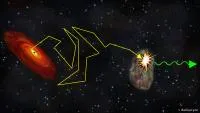
The black hole at the center of the galaxy would be acting as a huge particle accelerator. "It is similar to the experiments that the LHC (Large Hadron Collider) being built at CERN will be able to perform," explained astrophysicist David Ballantyne.
When complete, the LHC in Switzerland will be able to accelerate protons up to seven trillion electronvolts. Our galaxy's black hole launches protons to energies of 100 trillion electronvolts, according to the study conducted by the team. It is much more impressive because "Our black hole is quite inactive compared to the massive black holes in other galaxies," noted Ballantyne.
The astrophysicist collaborated with Professor Fulvio Melia on a new study published in Astrophysical Journal Letters.
After the high-energy protons escape from the black hole's environment, they go out into the interstellar medium where they collide with low-energy protons (hydrogen gas) in encounters so energetic that they form pions. These matter particles quickly decay into high-energy gamma rays that, like other radiation, travel in all directions.
The team finds that this process can explain the energy spectrum and brightness of the gamma emissions observed by HESS.