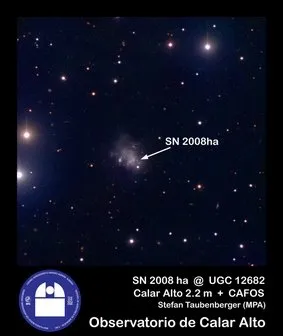
A team of European astronomers thinks that a recent supernova might not be as normal as thought. Instead, the star that exploded would have collapsed into a black hole, producing a jet, typical of much more violent events, gamma-ray bursts. The object, SN 2008D, would thus be one of the weakest explosions to produce fast-moving jets. The research, however, points to different interpretations from previous ones.
These results, partially based on observations made with ESO's Very Large Telescope, appear in the online edition of Science Express on July 24.
Stars that at birth were more than eight times as massive as the Sun end their relatively short lives in a cosmic cataclysm that forms the densest objects that exist: neutron stars and black holes. When they explode, some of the most massive stars emit a short cry of agony in the form of a gamma-ray burst (Gamma Ray Burst or GRB).
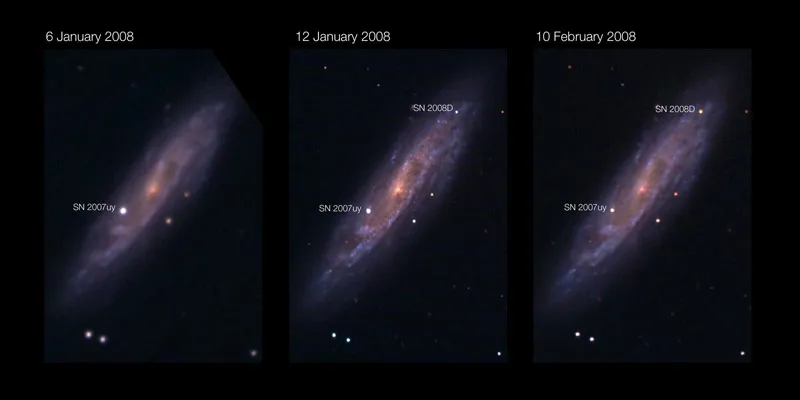
On January 9, 2008, the Swift satellite accidentally discovered a long 5-minute X-ray burst in the spiral galaxy NGC 2770, located 90 million light-years away in the constellation Lynx. The satellite was studying a supernova (SN 2007uy) that exploded the previous year in the same galaxy, but the burst came from another supernova: SN 2008D, as we reported in
"The Scream of a Supernova"
Researchers at the Italian National Institute of Astrophysics (INAF), the Max Planck Institute (MPA), the European Organization for Astronomical Research in the Southern Hemisphere (ESO) and other institutions observed the supernova at great lengths. The team is led by Paolo Mazzali of the Padova Observatory of INAF and MPA.
"What makes this event very interesting is that the X-ray signal was very weak and 'soft' (astronomers classify X-rays as soft when the relative amount of high-energy X-rays is less than that of lower-energy ones), very different from a gamma-ray burst and more in line with what is expected from a normal supernova," explains Mazzali.
After the discovery, the team quickly observed the supernova from the Asiago Observatory in northern Italy and established that it is a Type Ic supernova.
"These are supernovae produced by stars that have lost their outer layers rich in hydrogen and helium before exploding, and are the only type of supernova that are associated with (long) gamma-ray bursts. The object thus becomes much more interesting," says Mazzali.
Earlier this year, an independent team of astronomers reported in the journal Nature that SN 2008D is a fairly normal supernova. The fact that X-rays were detected, they said, was because for the first time astronomers were lucky enough to catch the star in the act of exploding.
Mazzali and his team think differently. "Our observations and models show that it is a rather unusual event, to be better understood in terms of an object that lies at the boundary between a normal supernova and gamma-ray bursts."
The team established an observational campaign to monitor the evolution of the supernova using several telescopes and collecting a large amount of data. The early behavior of the supernova indicated that it was a highly energetic event, although not as powerful as a gamma-ray burst. After a few days, however, the supernova's spectrum began to change. In particular, helium lines appeared, showing that the progenitor star was not stripped as deeply as supernovae associated with GRBs.
Over the years, Mazzali and his group developed theoretical models to analyze the properties of supernovae. When they applied them to SN 2008D, their models indicated that the progenitor star was, at birth, 30 times more massive than the Sun, but lost so much mass at the moment of explosion that the star had between 8 and 10 solar masses. The likely outcome for the collapse of such a massive star is a black hole.
"Since the masses and energies involved are lower than in every known GRB related to supernovae, we think that the collapse of the star gave rise to a weak jet and the presence of the helium layer made it more difficult for the jet to remain collimated [light whose rays are parallel to each other], so when emerging from the stellar surface the signal was weak," says Massimo Della Valle, co-author.
"The scenario we propose implies that the internal engine activity of the gamma-ray burst type exists in all supernovae that form a black hole," adds Stefano Valenti.
"As our X-ray and gamma-ray instruments become more advanced, we are slowly unveiling the very diverse properties of stellar explosions," comments Guido Chincarini, co-author and principal investigator of the Italian research on GRB bursts. "The bright gamma-ray bursts were the easiest to discover and now we are seeing variations on the theme that link these special events with more normal ones."
These are, however, very important discoveries, as they continue to paint the picture of how massive stars end their lives, producing dense objects and injecting new chemical elements into the gas from which new stars will form.
Sources and related links
- ESO: THE QUIET EXPLOSION
- The Metamorphosis of Supernova SN 2008D/XRF 080109: A Link Between Supernovae and GRBs/Hypernovae
Science Express July 24
DOI:10.1126/science.1158088
About the images
Credit: ESO PR Photo 23b/08
NGC 2770, SN 2007uy and SN 2008D