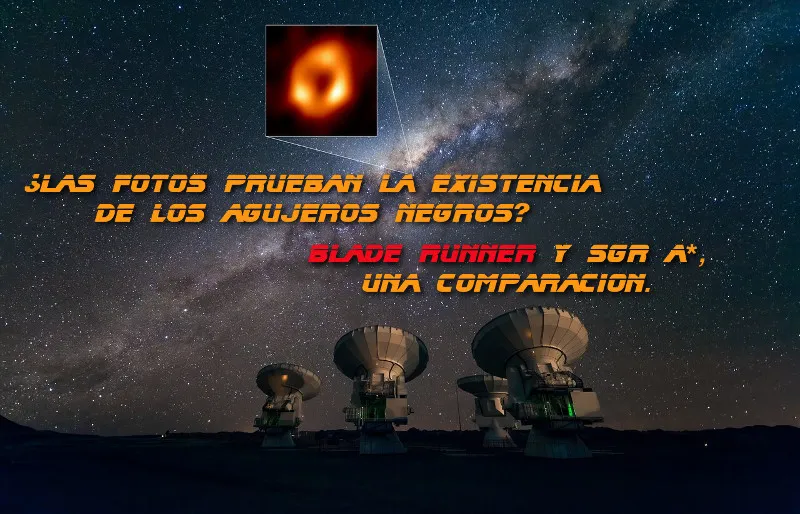
Blade Runner and Sgr A*, a comparison.
In Ridley Scott's film, the dilemma of identifying and differentiating androids from human beings is presented. These new robots look and behave like us. They are even afraid of dying (of their energy running out) and have implanted memories, so they can experience feelings. To differentiate one of these Nexus from a human being, we cannot use X-rays. If it were by a photo, could we tell by appearance if Roy Batty is a robot? It turns out that these androids are good imitators of people.
Black holes could also have good imitators. Speculation has included boson stars and other exotic objects that would behave similarly to a black hole, without being one. The version I like the most is that of "compact dark matter objects". One option that has been postulated is that there could be objects made only of dark matter, which would not interact with electromagnetism, but would have gravitational effects. Such an object would be difficult to distinguish from a black hole. It has even been speculated that dark matter could collapse into a dark...black hole.
Therefore, bad news: science does not provide absolute truths (fortunately). This case is no exception. In the press release from the Instituto de Astrofísica de Andalucía, this paragraph is included: "Now, thanks to the EHT, we have been able to obtain the first visual confirmation that this object is, almost certainly, a black hole with properties that perfectly agree with Einstein's General Theory of Relativity", says José Luis Gómez, a member of the EHT Scientific Council (...)". The emphasis in bold is mine.
In any case, we could rely on the popular saying: If it barks, has four legs and wags its tail, it's a dog. The sum of evidence indicates that the central object of the Milky Way is almost certainly a black hole...or a wolf.
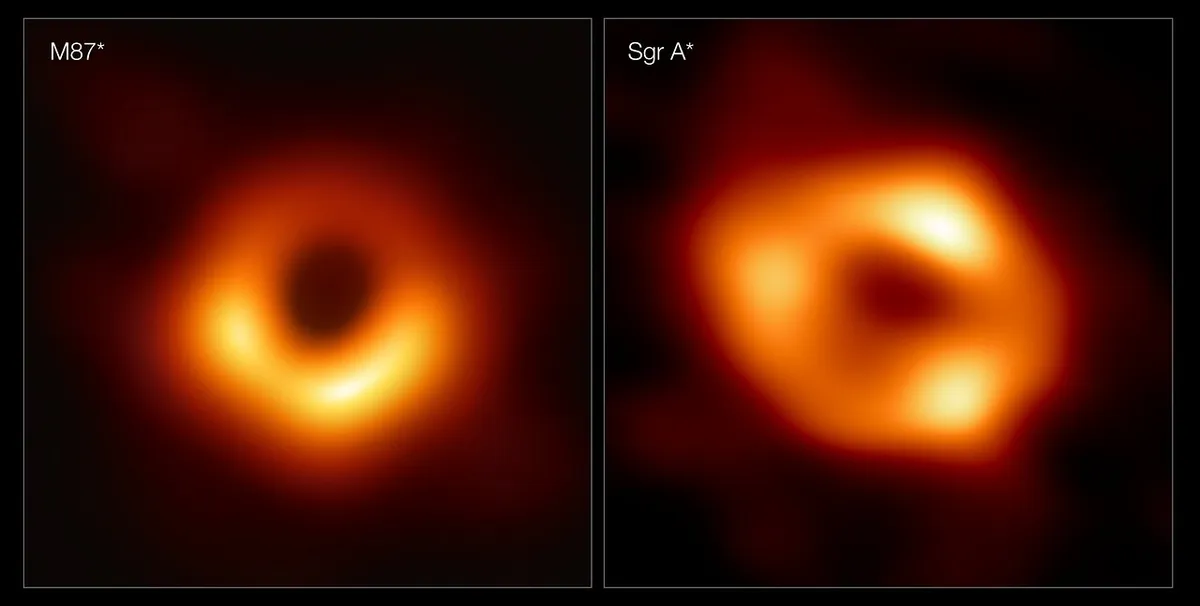
AN INGENIOUS IMAGE
The value of the recently published image of Sagittarius A*, as well as the previous one of the central black hole of M87, lies elsewhere.
First, because the process of image acquisition and processing is pushing the known limits, improving the technique of Very Long Baseline Interferometry. The computational processing of all the data is very demanding, complex, almost artistic. Soon, not only photos but videos will be published.
On the other hand, although the images may seem bland, without many features and very similar to each other, they provide valuable data for the research of these compact objects.
The mere fact of being able to make these images is astonishing. The angular size of both black holes is similar and is measured in μ-arcsec (micro-arcseconds). But instead of creating a radio telescope as big as the planet, astronomers combine several telescopes scattered across the Earth's surface, a lot of work and great ingenuity.
What is striking about these visual records with radio data is not their aesthetic beauty. It is not a photo of M42 or the Pillars of Creation. The beauty is in the meaning. The length scales are so large they defy reason. With Hubble and other telescopes, much more distant galaxies have been photographed, billions of light-years away, compared to the mere 27 thousand light-years of the galactic center. But Sgr A* is much smaller than a galaxy.
The data acquired by each radio telescope separately are meaningless. They are like pieces of a puzzle. Isolated, they mean nothing. Only by putting them together does the image become visible. In a puzzle, each piece connects to others by its shape. In this case, there is more than one way to combine the data, which produces different images. It is curious that astronomers must manipulate the data to make them realistic.
If we told Edwin Hubble, Carl Sagan, Stephen Hawking, Albert Einstein that this photo could be taken, they would not believe it. A century ago, the idea of doing this was completely outlandish. 50 years ago. 20 years ago. 10 years ago.
I believe we can then justify one last expression: I've seen things you people wouldn't believe.☉
Sources and related links
- Astronomers reveal first image of the black hole at the heart of our galaxy
https://www.eso.org/public/spain/news/eso2208-eht-mw/ - First image of the black hole at the center of our galaxy obtained
https://www.iaa.csic.es/noticias/se-obtiene-primera-imagen-agujero-negro-centro-nuestra-galaxia - Compact Dark Matter Objects via N Dark Sectors
Gia Dvali, Emmanouil Koutsangelas, Florian Kuhnel
https://arxiv.org/abs/1911.13281 - New Class of Dark Matter Objects and their Detection
C Sivaram et al
https://arxiv.org/abs/0910.2306
About the images
EHT Collaboration