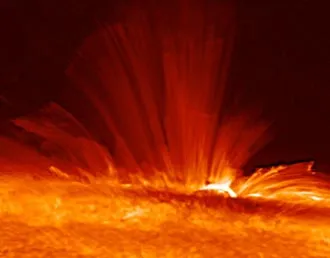
The National Aeronautics and Space Administration (NASA) today released for the first time high-resolution images showing that magnetic activity in the Sun's atmosphere is much more dynamic than previously known.
Via NASA and Milenio
In the images, 'small granules of hot gas rising and falling in the magnetized atmosphere of the sun can be distinguished,' said Dick Fisher, director of NASA's Heliophysics Division, in a statement.
The images were captured by the international Hinode spacecraft, launched into space on September 23 last to study the Sun's magnetic field and how its explosive energy propagates through different layers of its atmosphere.
Taken with an optical telescope, an X-ray telescope, and an ultraviolet spectrograph, the images focus on the solar atmosphere from the Sun's visible surface, called the photosphere, to the corona that extends into the solar system, explained Fisher.
These images 'will open a new era of study of some of the Sun's processes that have an impact on Earth, on astronauts, satellites, and the solar system,' he added.
John Davis, a scientist at NASA's Marshall Space Flight Center, indicated in Alabama that by coordinating the measurements of the three instruments, the changes occurring in the structure of the magnetic field are observed.
It shows the release of magnetic energy into the corona and interplanetary space to shape space weather, which involves the production of energetic particles and emissions of electromagnetic radiation, he detailed.
These energy explosions, he noted, can cut long-distance communications across entire continents and disrupt the global navigation system.
Hinode, whose images will have an impact on solar physics comparable to that of the Hubble Space Telescope in astronomy, is a mission led by the Japan Aerospace Exploration Agency and includes the European Space Agency.
The optical telescope captured fine-scale images of the Sun's lower atmosphere, while the X-ray telescope captured explosive events in the outer atmosphere, which will allow searching for evidence that magnetic reconnection is the cause of explosive activity.