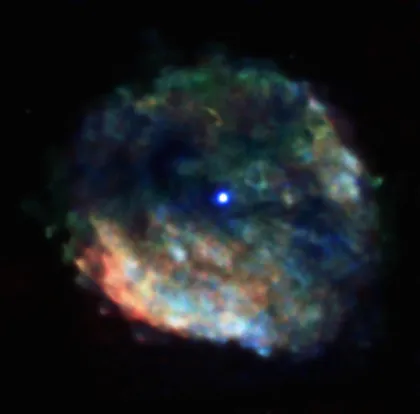
Astronomers believe they have found a new class of variable stars, which change in brightness. Events brighter than novae but less than supernovae could be caused by the merger of two stars or by a star swallowing a giant planet.
Via Kelly Young, NewScientist
Researchers led by Shrinivas Kulkarni of Caltech found an object that becomes 10 times brighter than novae but at least 10 times less bright than supernovae.
It is the latest of a handful of discoveries that point to a class of intermediate-brightness variable stars. While hunting for such stars, the team found an object in galaxy M85, which is about 60 million light-years away, that was not bright enough to be classified as a supernova. The initial observations came from Lick Observatory on January 7, 2006.
Using Palomar Observatory, Keck in Hawaii and Spitzer, the team found that the object, known as M85 OT 2006-1, remained at more or less the same brightness for two months and then gradually faded.
Kulkarni believes the observations point to a stellar merger. It is common to find pairs of stars and based on the observations, Kulkarni estimates that the stars in these binary systems were as massive as the Sun.
They called the object a "luminous red nova" for its brightness and tint.
It adds to a growing category of temporarily bright objects that are neither novae nor supernovae. They include stars M31 RV and V433 Sagittarii, which also turn red when they brighten, and V838 Monocerotis (in image).
Although V838 Mon is about 100 times fainter than the new object observed in M85, Kulkarni believes both resulted from stellar mergers.
Howard Bond, an astronomer at the Space Telescope Science Institute, thinks that colliding stars could explain all the objects in this new class. "In these objects, the energy released would be gravitational rather than thermonuclear," he added.
However, other astronomers say that the brightness in stars like V838 could be caused by a star swallowing one or more giant planets, possibly as it expands into a red giant.
But Kulkarni says the object in M85 released too much energy to be easily explained by the idea of a planet falling into its star.
Alon Retter, an astronomer at the University of Pennsylvania, disagrees. If the planet sank deep enough into the star, enough energy could be released to explain the observed brightness.
Related Links
Publication of the paper in Nature: An unusually brilliant transient in the galaxy M85