A neutron star, thought to be the product of a supernova explosion, known as RCW 103, possesses unusual X-ray emission and a slow rotation for its age.
When stars are massive, about 8 times the size of the Sun, they end their lives in a spectacular explosion called a supernova. The outer layers of the star are expelled into space at high speed, leaving remnants of gas and dust. Where the star was, its remnant is often found: a small, incredibly dense neutron star. Despite their small size, neutron stars contain more mass than the Sun.
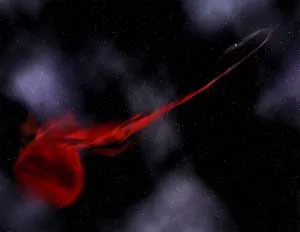
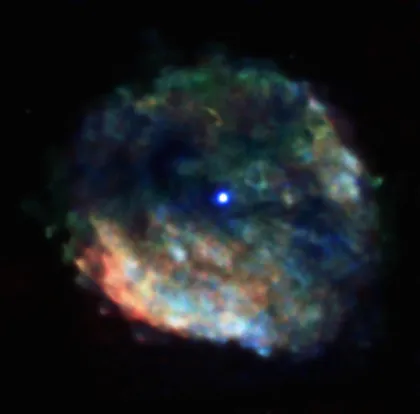
A new X-ray image shows the remnant of such an explosion, in the star RCW 103, about 10 thousand light-years from Earth. In the Chandra space telescope image, the colors red, green, and blue correspond to medium and high-energy X-rays. In the center, the bright blue dot, the neutron star that astronomers believe formed in the explosion. For several years, astronomers have tried to understand the behavior of this object, which exhibits unusually long variations in its X-ray emission over long periods. New evidence from Chandra implies that the star rotates once every 6.7 hours, confirming recent work by XMM-Newton. This is very slow for a neutron star of its age. A possible solution to the mystery is that a star too diffuse to be detected orbits around RCW 103. Gas flowing from the invisible neighbor toward the neutron star could be powering the X-ray emission and the interaction of the magnetic fields could have caused the neutron star to slow its rotation.
Data
Credit NASA/CXC/Penn State/G.Garmire et al
Scale Image is 11.9 arcmin across
Coordinates (J2000) RA 16h 17m 36.30s | Dec -51° 02' 24.40"
Constellation Norma
Observation Dates 02/08/2000 and 03/03/2002
Observation Time 18 hours and 53 minutes
Obs. IDs 970, 2759
Color Code Red (0.3 - 0.7 keV); Green (0.7 - 1.69 keV); Blue (1.69 - 3 keV)
Instrument ACIS
References G. Garmire et al. 2006, 36th COSPAR Scientific Assembly. p.3451
Distance Estimate About 10,000 light years
Release Date July 10, 2007
Sources and related links
- Note on Chandra
- RCW 103 in Rosat
- ESA XMM-Newton RCW 103
- Science Express:A long-period, violently-variable X-ray source in a young SNR;Vol. 313. no. 5788, pp. 814 - 817;DOI: 10.1126/science.1129185;A. De Luca,P. A. Caraveo,S. Mereghetti, A. Tiengo, G. F. Bignami