Two of the largest interferometers joined to study a red giant.
Using ESO's VLTI at Cerro Paranal and the VLBA operated by NRAO, an international team of astronomers has done what is possibly the most detailed study of the environment of a pulsating red giant. They performed, for the first time, coordinated observations of three outer layers of the star: the molecular layer, the dust layer and the maser layer, achieving significant progress in our understanding of the mechanism of how, before dying, evolved stars lose mass and return it to the interstellar medium.
Via ESO
Artist's impression - (c) ESO
S Orionis (S Ori) belongs to the class of Mira-type variable stars. It is a solar-mass star that, like the fate of our Sun, is near its sad end as a white dwarf. Mira-type stars are very large and lose large amounts of matter. Each year, S Ori ejects as much as the equivalent of Earth's mass into the cosmos.
"Since we are all stardust, studying the phases in a star's life when processed matter is returned to the interstellar medium to be used by the next generation of stars, planets...and humans, is very important," commented Markus Wittkowski, lead author of the paper reporting the results. A star like the Sun will lose between one third and half of its mass during the Mira phase.
S Ori pulsates with a period of 420 days. In the course of its cycle, its brightness changes by a factor of about 500 while its diameter varies by about 20%.
Although these stars are enormous -they are typically larger than the current Sun by a factor of a few hundred, for example, they can encompass Earth's orbit around the Sun- they are also distant and looking into their deep envelopes requires very high resolution. This can only be achieved with interferometric techniques.
"Astronomers are like doctors, who use various instruments to examine different parts of the human body," commented co-author David Boboltz. "While the mouth can be checked with a simple light, a stethoscope is needed to listen to the heartbeat. Similarly, the heart of a star can be observed in the optical spectrum, the molecular and dust layers can be studied in the infrared and the maser emission can be probed with radio instruments. Only the combination of the three gives us a more complete picture of the star and its envelope".
The maser emission comes from silicon monoxide molecules and can be used to photograph and track the motion of gas clouds in the stellar envelope about ten times the size of the Sun.
The astronomers observed S Ori with two of the available interferometric facilities: ESO's Very Large Telescope Interferometer (VLTI) at Paranal, observing in the near and mid-infrared, and NRAO's Very Long Baseline Array (VLBA) which performs measurements in the radio wave domain.
Since the star's luminosity changes periodically, the astronomers observed it simultaneously with both instruments at different epochs. The first occurred near the star's luminosity minimum and the last after the maximum of the next cycle.
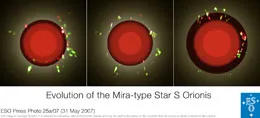
It was found that the diameter varies between 7.9 and 9.7 milliarcseconds. At the distance of S Ori, this corresponds to a change in radius from about 1.9 to 2.3 times the distance between Earth and the Sun or between 400 and 500 solar radii!
As if those sizes weren't enough, the inner dust layer was found to be about twice as large. The maser spots, which also form at approximately twice the star's radius, show the typical structure of partial or complete rings with a clumpy distribution. Their velocities indicate that the gas is expanding radially, moving away at a speed of about 10 kilometers per second.
The multi-wavelength analysis indicates that near the minimum there is more dust production and more mass ejection; in fact, in these phases the amount of dust is significantly greater than in the others.
After this intense production and ejection of matter the star continues its pulsation and, when it reaches its maximum luminosity, shows a much more expanded dust layer. This clearly supports a strong connection between the Mira pulsation and the production and expulsion of dust.
Furthermore, the astronomers discovered that aluminum oxide grains, also called corundum, constitute most of S Ori's dust layer. The grain size is estimated to be on the order of ten millionths of a centimeter, that is a thousand times smaller than the diameter of a human hair.
"We know one of the chapters of a Mira star's secret life, but much more can be learned in the near future, when we add to our already broad observational approach near-infrared interferometry with the VLTI's AMBER instrument," said Wittkowski.
The research is reported in Astronomy and Astrophysics ("The Mira variable S Ori: Relationships between the photosphere, molecular layer, dust shell, and SiO maser shell at 4 epochs", by M. Wittkowski et al.).
It is available as a PDF on the journal's website.
The team consists of Markus Wittkowski (ESO), David A. Boboltz (U.S. Naval Observatory, USA), Keiichi Ohnaka and Thomas Driebe (MPIfR Bonn, Germany), and Michael Scholz (University of Heidelberg, Germany and University of Sydney, Australia).
Notes
A maser is the microwave equivalent of the laser, which emits visible light. A maser, instead, emits powerful microwave radiation and its study requires radio telescopes. An astrophysical maser is a natural source of stimulated emission that can appear in molecular clouds, comets, planetary atmospheres, stellar atmospheres, or other varied conditions of interstellar space.
ESO operates the Very Large Telescope Interferometer at the Paranal Observatory, Chile, with four fixed 8.2-meter telescopes and four movable 1.8-meter telescopes, working at optical and infrared wavelengths.
NRAO operates the Very Long Baseline Array with 10 stations across the U.S. working at radio wavelengths between 3 mm and 90 cm (0.3-90 GHz).
ESO, NRAO and other partners will operate the Atacama Large Millimeter/submillimeter Array (ALMA) in Chile, working with millimeter wavelengths between 0.3 and 10 mm (30-950 GHz).
Related links
ESO press release