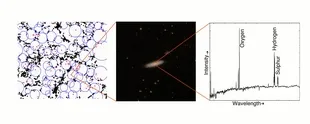
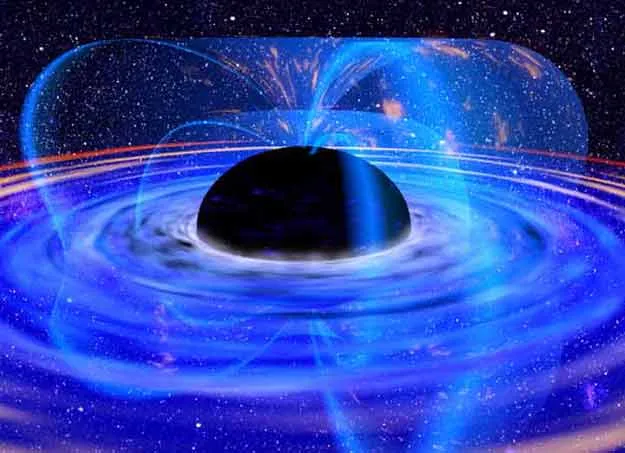
As announced by Chris Willott of the University of Ottawa in Canada, four very distant objects were detected, one of them at almost 13 billion light-years, which is considered a quasar powered by a supermassive black hole.
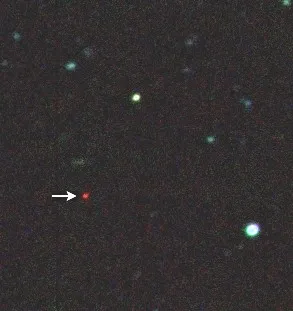
The arrow indicates the distant quasar - © Canada-France-Hawaii Telescope
For about a billion years, the first stars and galaxies were hidden behind a veil of hydrogen atoms that absorbed light until the ultraviolet light from young stars and from matter falling into giant black holes called quasars ionized the hydrogen to clear the fog.
The new quasar is the oldest found and astronomers hope it will help reveal how stars, galaxies and quasars formed during those dark ages of the universe.
The previous record had been found by the Sloan Digital Sky Survey and was an object with a redshift of 6.41, meaning that the wavelength of its light had been stretched by 641%.
A new study with the 3.5-meter Canada-France-Hawaii Telescope (CFHT) found four quasars with a redshift greater than 6, including one with the simple name CFHQS J2329-0301 with a record redshift of 6.43. This means we are seeing the object as it was only 870 million years after the Big Bang.
The new black hole powering the quasar is located in the constellation Pisces and weighs about 500 million solar masses. "Theoretically, it is very difficult to create a black hole this large so early in the universe," commented Willott.
The discovery was announced at the annual conference of the Canadian Astronomical Society and was submitted to the Astronomical Journal with the title "Four quasars above redshift 6 discovered by the Canada-France High-z Quasar Survey"
Authors: Chris J. Willott, Philippe Delorme, Alain Omont, Jacqueline Bergeron, Xavier Delfosse, Thierry Forveille, Loic Albert, Celine Reyle, Gary J. Hill, Michael Gully-Santiago, Phillip Vinten, David Crampton, John B. Hutchings, David Schade, Luc Simard, Marcin Sawicki, Alexandre Beelen, and Pierre Cox.
Related links
- ScienceNow:Heavyweight From the Distant Past
- NewScientist:New quasar is the oldest yet
- The Canada-France High-z Quasar Survey
- CFHT press release