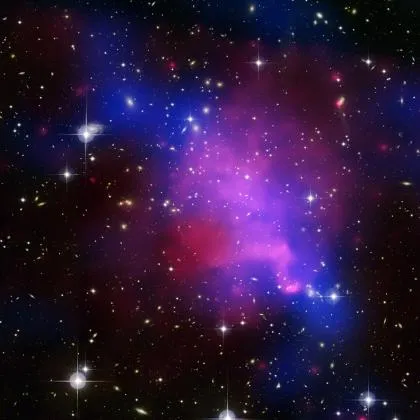
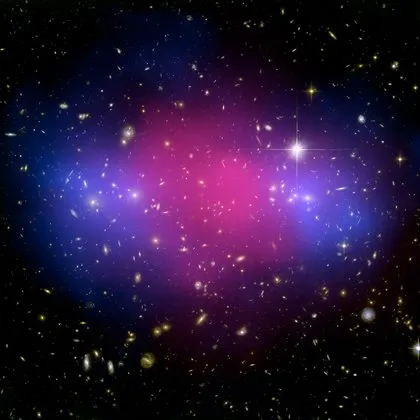
Astronomers using NASA's Hubble Space Telescope have discovered a ring of dark matter formed long ago during a titanic collision between two massive galaxy clusters.
Via HubbleSite
This is one of the strongest pieces of evidence for the existence of dark matter. For a long time, the existence of this invisible substance has been suspected as the source of additional gravity that held galaxies together in clusters, since if only visible matter were taken into account it would not be enough to prevent them from dispersing.
However, what exactly dark matter is remains unknown.
"This is the first time we have detected dark matter that has a unique structure that is different from the gas and galaxies in the cluster," commented astronomer M. James Jee of Johns Hopkins University, a member of the team that made the discovery.
The researchers came across the ring while mapping the distribution of dark matter in the galaxy cluster Cl 0024+17 (ZwCl 0024+1652), located 5 billion light-years from Earth. The ring measures 2.6 million light-years.
"Although invisible matter has been found before in other galaxy clusters, it was never detected so enormously separated from the gas and galaxies that form the clusters," said Jee.
This would allow for better study of how this matter behaves differently from normal matter.
In the analysis of the matter, the researchers noticed a ripple in the mysterious substance, somewhat similar to the ripples created in a pond when throwing a stone.
"I was annoyed when I saw the ring because I thought it was an error in the data (...) I couldn't believe my results. It took me more than a year to convince myself that the ring was real. I have looked at several clusters but I have seen nothing like this," continued Jee.
Curious about why the ring was in the cluster and how it formed, Jee found previous research suggesting that the cluster collided with another one 1 or 2 billion years ago. The research, published in 2002 by Oliver Czoske of the University of Bonn, was based on spectroscopic observations of the three-dimensional structure of the cluster. The study reveals two distinct groupings of galaxy clusters, indicating a collision between them.
Computer simulations of collisions, created by the team, show that when two clusters collide, the dark matter falls to the center of the combined clusters and splashes outward. As the dark matter moves outward, it begins to slow down under the pull of gravity and piles up.
"By studying this collision, we are seeing how dark matter responds to gravity," commented team member Holland Ford. "Nature is doing an experiment for us that we cannot do in the laboratory, and it agrees with our theoretical models."
Previous observations of the Bullet Cluster with Hubble and the Chandra X-ray observatory presented a side view of a similar encounter between two clusters. In that collision, dark matter was pushed apart from the hot gas, but the dark matter still followed the distribution of the galaxies. Cl 0024+17 is the first cluster to show a dark matter distribution that differs from the distribution of both the galaxies and the gas.
The team's paper will appear in the June 1st edition of Astrophysical Journal.