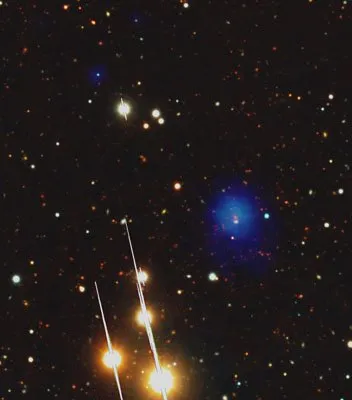
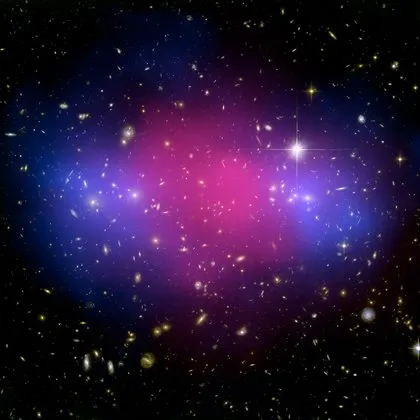
The Chandra X-ray Observatory and other observatories obtained an image of what remained from the collision of galactic clusters in which dark matter and galaxies are separated.
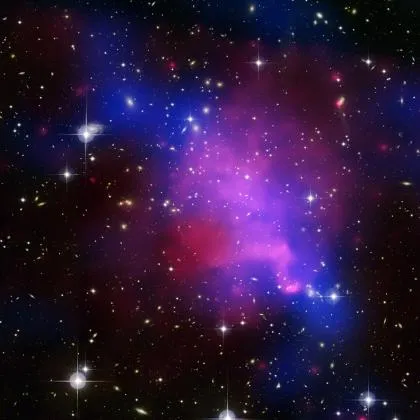
Abell 520 - Credit: X-ray: NASA/CXC/UVic./A.Mahdavi et al. Optical/Lensing: CFHT/UVic./A.Mahdavi et al.
This image of Abell 520 shows the aftermath of a galactic cluster collision. The hot gas detected by Chandra is in red. Optical data from the Keck and Subaru telescopes show the light from individual galaxies (yellow and orange). The location of most of the matter in the cluster (blue) was found by tracing the faint light-bending effects on distant galaxies. This material is dominated by dark matter.
Abell 520 has similarities with the so-called Bullet Cluster (1E0657-56). As in the latter, it seems that galaxies flew past each other when the clusters collided, as expected. Another parallel is that there are large separations between the regions where galaxies are most common and where most of the gas is.
However, there are significant differences as well. For example, a concentration of dark matter is found near the hot gas, where few galaxies are located. Furthermore, there is an area where there are many galaxies but little dark matter. Both things go against the popular theory that says dark matter and galaxies should be together, even in a violent collision.
These results lead to two possible explanations: one involves how galactic clusters interact and the other about the nature of dark matter itself.
The first option is that galaxies were separated from dark matter through complex gravitational tugs. The second is that dark matter is affected not only by gravity, but also by an as-yet-unknown interaction between dark matter particles. This second option would require many additional explanations and would be difficult, a priori, to reconcile with observations of other different objects like the Bullet Cluster.
The results will appear in the October 20 edition of The Astrophysical Journal.
More images at:
http://chandra.harvard.edu/photo/2007/a520/more.html
Sources and related links
- Note on Chandra
- Note on EurekAlert
- Note on UniverseToday