A powerful collision between galaxy clusters has been captured by the Hubble Space Telescope and the Chandra X-ray Observatory. The discovery provides evidence and new insights into dark matter.
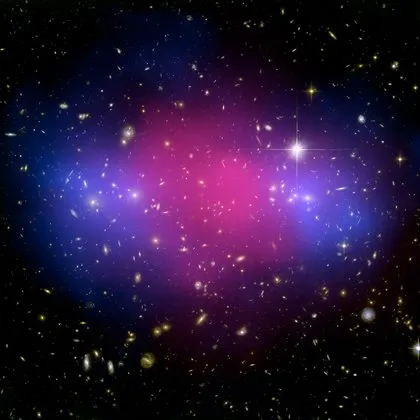
The new observations of the cluster known as MACSJ0025.4-1222 indicate that a titanic collision separated ordinary matter from dark matter. This provides independent confirmation of a similar effect previously detected in the Bullet Cluster, also known as 1E 0657-56, thus showing that the previous case is not an anomalous one.
In a way, MACS J0025 can be thought of as a "prequel" to the Bullet Cluster. Being at a greater distance (5.7 billion light-years) astronomers are seeing a collision that occurred much earlier than that of the Bullet Cluster.
There is, however, an important difference between the two: this newly discovered system does not contain a "bullet," that is, a dense core of gas that can be seen moving through the Bullet Cluster. However, the amount of energy involved in this gigantic collision now discovered is almost as extreme as that found in the Bullet Cluster.
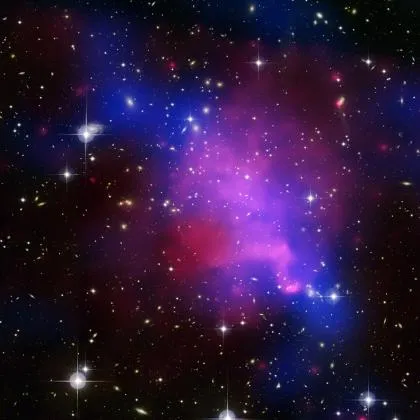
MACSJ0025 formed after an enormously energetic collision between two large clusters. Using visible light images from Hubble, astronomers were able to infer the total distribution of mass—whether normal or dark matter. Hubble was used to map the dark matter (colored in blue) using a technique known as gravitational lensing. Chandra data allowed astronomers to precisely map the ordinary matter, mostly in the form of hot gas, which shines brightly in X-rays (shown in pink).
As the clusters merged to form MACSJ0025 at speeds of millions of kilometers per hour, the hot gas in the clusters collided and slowed down, but the dark matter passed through this collision. The separation between the material shown in pink and in blue thus provides observational evidence for dark matter and supports the view that dark matter particles interact with each other very little or not at all, aside from the gravitational pull.
One of the great achievements of modern astronomy has been to establish an inventory of the matter and energy content of the universe. So-called dark matter makes up up to 23% of the content, five times more than ordinary matter. These new findings in MACS J0025 confirm the previous discoveries.
The team of astronomers in the study was led by Maruša Bradač of the University of California, Santa Barbara and Steve Allen of the Kavli Institute at Stanford University. Their results will appear in an upcoming issue of The Astrophysical Journal.
Sources and related links
- SpaceTelescope:Clash of clusters provides new dark matter clue
- Chandra: A Clash of Clusters Provides Another Clue to Dark Matter
- Revealing the properties of dark matter in the merging cluster MACSJ0025.4-1222
Maruša Bradač, Steven Allen et al.
Accepted for publication in The Astrophysical Journal
arXiv:0806.2320v2
About the images
Credit:NASA, ESA, CXC, M. Bradac (University of California, Santa Barbara, USA), and S. Allen (Stanford University, USA).