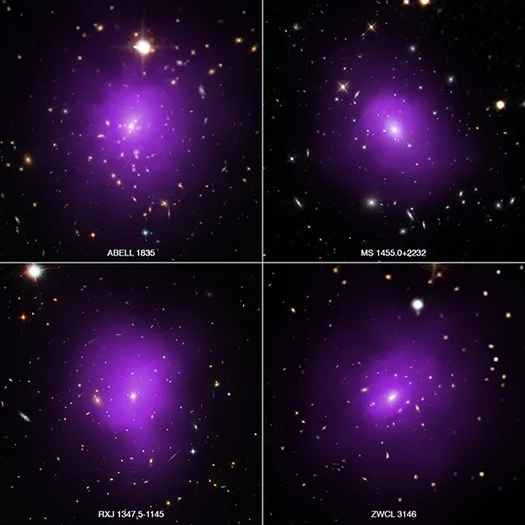
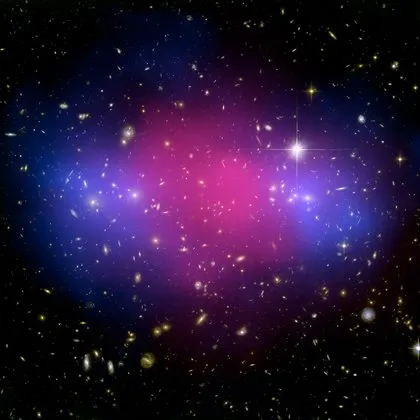
Scientists discovered the most massive cluster of galaxies seen in the distant universe so far. The discovery would confirm the existence of dark energy.
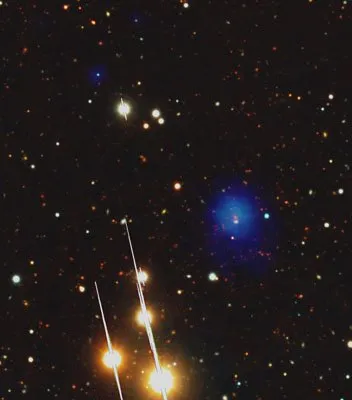
The new "monster" known only by its catalog number as 2XMM J083026+524133, would contain as much mass as a thousand large galaxies. It was observed for the first time, by chance, when ESA's orbital X-ray Observatory, XMM-Newton, was studying another celestial object, and was listed in a catalog for future follow-up.
Georg Lamer, from the Astrophysikalisches Institut Potsdam in Germany and a team of astronomers discovered the cluster by doing a systematic analysis of the catalog. Based on 3500 observations with the EPIC camera on XMM-Newton covering about 1% of the entire sky, the catalog contains more than 190,000 X-ray sources. The team was searching for extended regions of X-rays that could be nearby galaxies or distant clusters.
J083026+524133 was dismissed for being too bright. When checking visual images from the Sloan Digital Sky Survey, the team could not find any obvious nearby galaxy at that location. So they went to the Large Binocular Telescope in Arizona and took a long exposure. And they found the galaxy cluster. The team calculated a distance of 7.7 billion light-years, which is not a surprise since XMM-Newton is sensitive enough to find clusters at that distance. The surprise was that the cluster contains thousands of times the mass of our own Milky Way.
"Such massive galaxy clusters are thought to be rare objects in the distant universe. They can be used to test cosmological theories," says Lamer. In fact, the very presence of this cluster would confirm the existence of a mysterious component of the universe: dark energy.
No one knows what dark energy is, what it is made of, but it is believed to be the cause of the acceleration of the expansion of the universe. This makes it difficult for massive galaxy clusters to grow in more recent times, indicating that they must have formed earlier in the universe. "The existence of the cluster can only be explained by dark energy," says Lamer.
"According to current cosmological theories, we should only expect this single cluster in the 1% of the sky we have searched," adds Lamer. That is, it is a cluster sufficiently distant and massive to think that there must be only a few in the entire universe, or in other words, the team found a needle in a haystack.
Sources and related links
- XMM-Newton’s massive discovery
- 2XMM J083026+524133: The most X-ray luminous cluster at redshift 1
G. Lamer, M. Hoeft, J. Kohnert, A. Schwope, and J. Storm
A&A 487, L33-L36 Vol. 487 No. 2 (August IV 2008)
DOI:10.1051/0004-6361:200810255 - arXiv:2XMM J083026+524133: The most X-ray luminous cluster at redshift 1
G. Lamer, M. Hoeft, J. Kohnert, A. Schwope, J. Storm
arXiv:0805.3817v3
About the images
Credit:ESA XMM-Newton/EPIC, LBT/LBC, AIP (J. Kohnert)