An almost complete Einstein ring.
To see into the deepest space, a regular telescope is no good. But one can make use of the power of a massive galaxy that bends the light of another that is even more distant, which is called a gravitational lens. And a European team of astronomers has found one of the luckiest discoveries of all, an Einstein ring, where the lens and the more distant galaxy align almost perfectly. Due to its unique shape, they call it "The Cosmic Horseshoe".
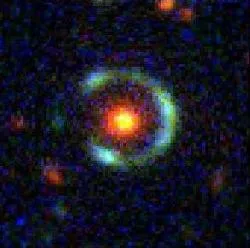
An almost complete Einstein ring. Image:SDSS
The discovery was made by more than a dozen astronomers from a handful of European universities, from England to Russia. The paper in which they publish the discovery is called "The Cosmic Horseshoe: Discovery of an Einstein Ring around a Giant Luminous Red Galaxy", which has been submitted to Astrophysics Journal.
The object was found while cleaning up data from the Sloan Digital Sky Survey. This survey uses robotic telescopes to capture images of the sky; eventually it will make a map of 25%, seeing about 100 million objects. Astronomers regularly look through this vast amount of data and find all kinds of interesting objects.
Then, the researchers made observations using the 2.5m Isaac Newton telescope in La Palma and the 6m BTA telescope in Russia. This gave them the image shown in the note, as well as spectral information to determine the chemical constituents of the lens and the background object.
In the image, a red spherical galaxy is seen almost completely surrounded by a blue ring. In reality, it is a relatively nearby galaxy, located at 4.6 billion light-years (the lens) and then a more distant blue galaxy, at 10.9 billion light-years.
From our point of view, they align almost perfectly, so the light from the blue galaxy is focused by the gravity of the lens.
The lens is an extremely red galaxy, containing about 5 trillion times the mass of the Sun. For comparison, our Milky Way contains only 580 billion solar masses.
The more distant galaxy is a galaxy with a very high rate of star formation - evidenced by the blue spectrum of its light. If it weren't behind the lens, astronomers wouldn't even know it's there. But being right behind it, its light has been focused into an almost complete ring around the lens.
The discovery gives astronomers two useful additional research directions: the distribution of dark matter around luminous red galaxies and star formation in the early universe.