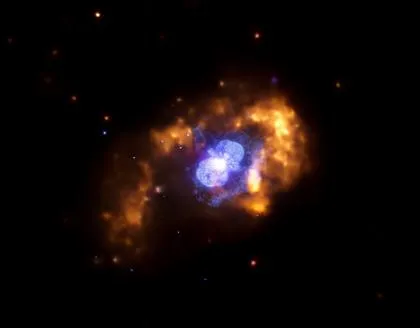
Eta Carinae. Credit: X-ray: NASA/CXC/GSFC/M.Corcoran et al.; Optical: NASA/STScI
Eta Carinae is a mysterious, extremely bright and unstable star located about 7,500 light-years away. It is thought to be consuming its nuclear fuel at an incredible rate, while rapidly approaching its explosive demise.
When the star explodes, it will shine spectacularly, perhaps brighter than the Moon.
Its fate has been anticipated by the recent discovery of SN2006gy, a supernova in a nearby galaxy that was the brightest explosion ever seen. The erratic behavior of the star that exploded in that supernova suggests that Eta Carinae could explode at any moment.
The star, which is between 100 and 150 times more massive than the Sun, is near the point of imbalance where gravity is almost balanced by the outward pressure of the intense radiation generated in the nuclear furnace. This means that small perturbations of the star can cause huge ejections of matter from its surface. In the 1840s, Eta Carinae had a massive eruption, of about 10 solar masses, to briefly become the second brightest star in the sky. Such an explosion would have shattered another star, but Eta Carinae survived.
The latest image composite shows the remnants of a titanic event with new data from the Chandra X-ray Observatory and the Hubble Space Telescope. The blue regions show the cold optical emission, detected by Hubble, from dust and gas expelled from the star. This debris forms a bipolar shell around the star, which lies near the brightest point of the optical emission. This shell is surrounded by a cloud of fainter material. A jet of material from the star is seen in the image pointing up and to the left.
The Chandra data in orange and yellow show the X-ray emission produced when the expelled material slams into the nearby gas and dust, heating the gas to temperatures of millions of degrees. The X-ray observations show that the outer expelled material is enriched with complex atoms, especially nitrogen, made in the star's nuclear furnace. The data also show X-ray emissions generated by the high-speed collision of winds from the surface of Eta Carinae (moving at about 1 million miles per hour) with the wind from a stellar companion.
This companion is not directly visible in these images, but the variation in X-rays in the regions close to the star indicate its presence. Astronomers do not know what role this companion has in the evolution of Eta Carinae or what role it will play in the future.