An international team of astronomers has obtained new evidence that the object called VIRGOHI21 is an object the size of a galaxy, made entirely of dark matter.
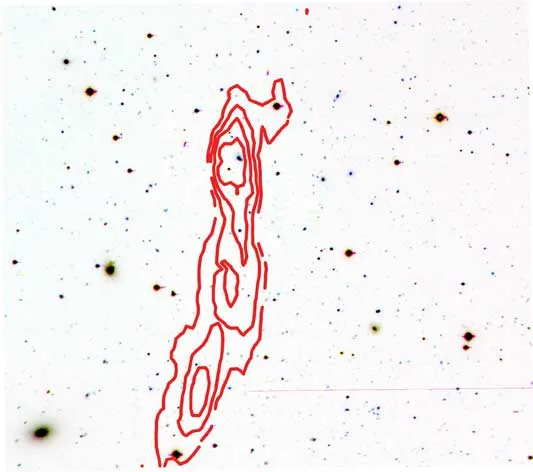
VIRGOHI21 has no stars, but radio waves from neutral hydrogen managed to identify it. The contours superimposed on this negative image from the Isaac Newton Telescope in the Canary Islands indicate how much gas was detected with the Westerbork Synthesis Radio Telescope.
Credit: R. Minchin / Arecibo Observatory / Cardiff University / Isaac Newton Telescope / Westerbork Synthesis Radio Telescope
In the paper titled "21-cm synthesis observations of VIRGOHI 21 - a possible dark galaxy in the Virgo Cluster" the researchers provide new data about this mystery, located in the Virgo Cluster.
The team conducted high-resolution observations of the object using the Westerbork Synthesis Radio Telescope (WSRT) to establish the amount of neutral hydrogen gas. They also conducted follow-up observations with Hubble, looking for any evidence of stars.
Astronomers suspected there was an invisible galaxy out there when they spied on the galaxy NGC 4254. This rare galaxy appears to be the partner of another in a cosmic collision. All the normal evidence is there: gas is being dragged into a faint stream and one of its spiral arms is being stretched.
But the companion in this collision is nowhere to be seen.
The researchers calculated that an object with 100 billion solar masses must have collided with NGC 4254 in the past, in the last 100 million years, creating the gas stream and tearing off one of its arms. This was the clue that an invisible dark matter galaxy must be hiding nearby.
A detailed search turned up the mysterious object called VIRGOHI21, located about 50 million light-years from Earth. If it were a normal galaxy, it would be possible to see it with a powerful amateur telescope, but there is nothing there. Not even Hubble managed to capture any star from this massive region of space.
It was visible only with radio telescopes, which can detect the radio emissions from the neutral hydrogen gas located in the cloud.
When the research was first published, a few years ago, the astronomical community was logically skeptical and proposed several theoretical alternatives to explain the mysterious object.
For example, there could be additional mass associated with VIRGOHI21, and not just dark matter. The discovery of red giant stars in the region would give some indication that this is a more normal interaction. But Hubble found nothing.
Dr. Robert Minchin, lead researcher at the Arecibo Observatory, said "not even the power of Hubble has been able to see any star there".
However, there seem to be ways for galaxies and their dark matter to separate. Recently, a ring of dark matter was found around a group of colliding galaxy clusters by the space telescope. Perhaps VIRGOHI21 is the remnant of one of these cluster collisions; a chunk of dark matter flung into space.
A new sky survey, carried out by the 305m radio telescope at Arecibo in Puerto Rico, will search for more of these objects in the future. The survey is called the Arecibo Galaxy Environment Survey (AGES).
The study's paper has been accepted for publication in the Astrophysical Journal.
Sources and related links
- UniverseToday:No Stars Shine in This Dark Galaxy
- 21-cm synthesis observations of VIRGOHI 21 - a possible dark galaxy in the Virgo Cluster
- NAIC:New Results Confirm Dark Galaxy Existence