The Hubble Space Telescope managed to capture in detail the vivid colors of the star-forming dwarf galaxy, located 12.5 million light-years away.
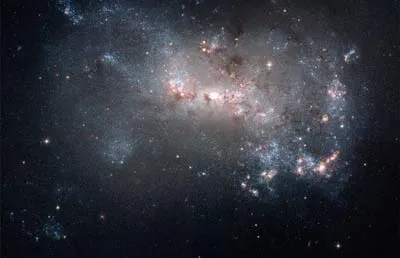
Hundreds of thousands of vibrant blue and red stars are visible in this image of galaxy NGC 4449 taken by Hubble. Hot white-blue clusters of massive stars are scattered across the galaxy, interspersed with numerous reddish dust regions of current star formation. Silhouettes of massive dark clouds of gas and dust are glimpsed in the starlight.
The galaxy has been forming stars for billions of years, but it is currently experiencing formation events at much higher rates than in the past. This unusual explosion and intense star-forming activity qualifies as a Starburst (in Spanish it would be an estallido or eclosión or erupción estelar).
At the current rate, the gas fueling star formation will last for only one billion years.
Starbursts usually occur in the central regions of galaxies, but NGC 4449 has more widespread activity, as the youngest stars are observed both in the nucleus and in the surroundings.
A global outburst like this resembles primordial galaxies that grew by merging with smaller systems. Since NGC 4449 is close enough to be observed in great detail, it is the ideal laboratory for investigating what might have happened during galactic formation and evolution in the early universe.
The galaxy belongs to a group in the constellation Canes Venatici, the hunting dogs. Astronomers think that star formation in the galaxy has been influenced by interactions with several of its neighbors.
The image was taken in November 2005 by an international team led by Alessandra Aloisi of ESA. Other team members were Francesca Annibali (STScI), Claus Leitherer (STScI), Jennifer Mack (STScI), Marco Sirianni (ESA/STScI), Monica Tosi (INAF-OAB), and Roeland van der Marel (STScI).
The Hubble's Advanced Camera for Surveys (ACS) observed the galaxy in different regions of the spectrum: visible (blue and green), infrared and hydrogen-alpha.
Sources and related links
- Press releases, images and videos at:
ESA: Stellar fireworks through Hubble’s eyes - SpaceTelescope: Stellar fireworks are ablaze in galaxy NGC 4449 and Hubble Site
- Another Starburst Galaxy NGC 1313, by ESO in "THE 'UPSIDE-DOWN' GALAXY", November 23, 2006