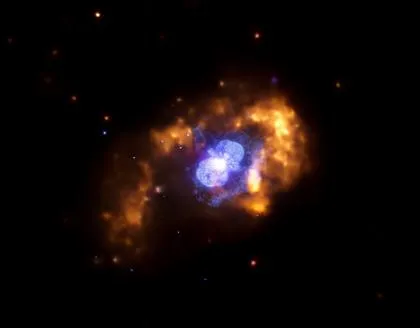
The two most massive stars ever discovered are orbiting each other 20,000 light-years from Earth, near the center of our galaxy. The heavier one is 114 times more massive than the Sun -so large that according to some astronomers it should have exploded.
In the center of the cluster, the pair of stars A1 would be the heaviest known. Image: HST.
Via Stuart Clark, NewScientist.com
Anthony Moffat of the University of Montreal announced the discovery of the stars, named "A1" at the Meeting of the Canadian Astronomical Society in Kingston, Ontario.
Some stars whose mass exceeded 100 suns had already been discovered, but this finding, apparently, breaks all records. The previous record also belonged to a binary system. WR20a or Westerlund 2, as it was called, is a duo of stars of about 80 solar masses each.
The measurement is possible because the two stars, in the cluster NGC 3603, are orbiting each other. This allows astronomers to observe the lengthening and narrowing of the light, due to the Doppler effect, as the stars race around each other completing an orbit in 3.8 days.
Moffat and his colleagues collected the Doppler data using the ESO's Very Large Telescope (VLT) in Chile. Knowing the speed of the stars, and their distance, their mass could be calculated so that gravity keeps them in that orbit.
"I am amazed and very curious," said astrophysicist John Brown of the University of Glasgow, who is not a member of the team. "I didn't think stars this big could exist, they should explode into pieces."
The more massive a star is, the more radiation it generates within its core. That increases the pressure exerted on the outer layers of the star as the radiation struggles to escape into space.
In the same cluster another binary system was found, named C in the image, with an orbital period of 8.92 days, although the masses of its components, which are also expected to be high, are not yet available.
The most massive star
New source of gamma-ray energy
Double Stars Emerge As New Heavyweight Champions