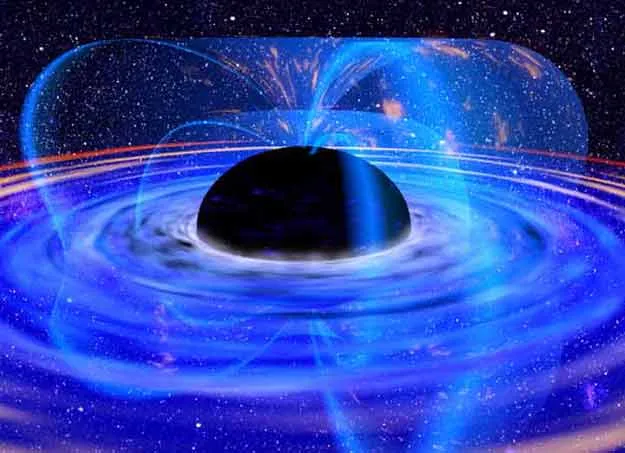
Supermassive, active and growing black holes in galactic centers are common even in cosmic voids, the most rarefied and lonely regions of the universe.
Via Physorg
In a study of more than 1000 galaxies using the Sloan Digital Sky Survey (SDSS-II), astronomers from Drexel and Widener universities announced that the growth of these monsters -with masses of millions to hundreds of millions of suns- is found where galaxies are spread out and interact very little with each other. The researchers also found that the accretion of matter onto these black holes is slower than in denser galactic environments.
The discoveries shed light on the formation and evolution of black holes by showing that the environment affects how fast galaxies go through their evolutionary cycle.
The simple presence of a supermassive black hole in sparsely populated areas -we could say "rural"- challenges current theoretical models of galaxy formation and structure evolution, as explained by Anca Constantin of Drexel University, author of the paper presented at the Meeting of the American Astronomical Society in Hawaii.
Void regions fill half of the Universe. Only 5% of all galaxies live in these bubble-like regions. The other 95% live in crowded communities in clusters, filaments and walls, which could be compared to the cities and suburbs of the Universe.
Studying a 700-million-light-year slice of the cosmos, the researchers found that the spectra of the galactic centers in void regions show hot ionized gases from the light emitted by matter around supermassive black holes. According to the author, the more isolated the accretion disk of a black hole is, the less active it is than in populous regions, and fuel seems to be less available for accretion in voids than in the "urban regions".
Astronomer Fiona Hoyle, a member of the discovery team from Widener University, adds: "This is strange given that these lonely galaxies are forming stars at higher rates than their counterparts in denser regions; this means there is plenty of fuel, but it is not channeled efficiently toward the central engine."
The data studied by Constantin may also demonstrate that active black holes seem to be more common in voids but only among small galaxies, while they are less common among massive galaxies. This also gives a clue that the life cycle in black hole growth is delayed or slowed down in voids compared to denser regions.
These results have been possible only thanks to a reduced number of void regions and void galaxies found in the SDSS-II data. The sample used in the analysis comprises more than 1000 void galaxies. Previously, the accretion of black holes in the centers of void galaxies had been studied only in a handful of objects contained in one void region, the Boötes Void.
The results are described in the article "Active Galactic Nuclei in Void Regions" submitted for publication in The Astrophysical Journal.
Related links
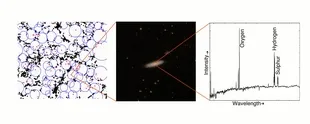
In the image: A slice of about 700 million light-years of the distribution of galaxies in the universe. The voids are marked as blue circles, and the galaxies in red. The image shows a void galaxy that harbors a black hole with active accretion at its center; such activity is revealed in the optical spectrum exhibiting emission peaks, characteristic of gases ionized by the light emitted by matter swirling around a supermassive black hole.
PDF: Active Galactic Nuclei in Void Regions
Drexel press release