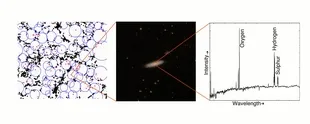
Astrophysicists think that galaxies grow by absorbing smaller galaxies. Now, using supercomputers to simulate galactic mergers, scientists at Stanford have seen the formation of a new type of structure: a central gas disk that can be hundreds to thousands of light-years across and of a few hundred million to billions of solar masses.
Credit: Image courtesy of Stanford University
Via EurekAlert
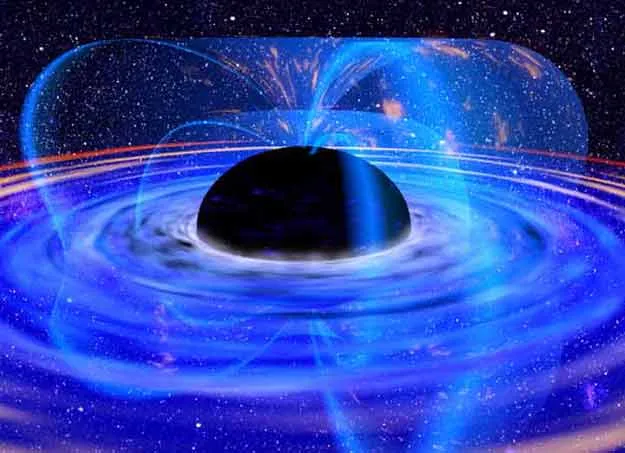
The report of the first simulation of the formation of a pair of supermassive black holes (SMBH, Super Massive Black Hole) is published in the online edition of Science Express.
"The theory of General Relativity that Einstein developed 90 years ago that describes the behavior of gravity has been verified in many of its predictions," says the paper's co-author Stelios Kazantzidis of the Kavli Institute for Particle Astrophysics and Cosmology. "However, there is one important consequence of this theory that has escaped verification and that is the existence of gravitational waves. Due to the fact that colliding pairs of SMBHs constitute the most powerful source of gravitational wave emission in the universe, it is of primary importance to establish the necessary conditions for the merger of two SMBHs," he concluded.
Kazantzidis and Lucio Mayer of the Swiss Federal Institute of Technology and the University of Zurich, the lead authors, conceived the project and designed and conducted the numerical simulations.
Monica Colpi of the University of Milano-Bicocca and Piero Madau of the University of California, Santa Cruz, helped interpret the results. Thomas Quinn of the University of Washington and James Wadsley of McMaster University wrote the code used for the simulation.
A binary SMBH consists of two SMBHs orbiting around their center of mass. The black holes may or may not merge, depending on the existence of a mechanism that can extract angular momentum from their orbits and reduce their relative separation, Kazantzidis explained.
"A pair of SMBHs can interact with the stars that surround them or with their gas. In both cases, the gas and the stars exert a frictional force on the black holes that extracts energy from the orbital motion of the holes. As a result, the separation between them gradually shrinks."
It is not clear, however, whether gas friction or stellar friction is what dominates the process.
Previous authors have investigated the formation of these objects using simulations, but in this new case, the researchers followed the process over a wide range of temporal and spatial scales.
"With a few exceptions, previous studies did not explore the role of gas in the evolution of these SMBH pairs. Theoretical and observational evidence suggests that the central regions of merger remnants contain amounts of gas. Our simulations provide further data on black hole pairs and their merger and highlight the vital role of the gas component of galaxies in determining the fate of the black holes."
The results are good news for LISA, the Laser Interferometer Space Antenna experiment, a space observatory designed to detect gravitational waves using laser interferometry over astronomical distances. LISA, therefore, is ideal for testing the merger of supermassive black holes like those simulated by Kazantzidis and his colleagues. LISA is expected to begin its observations around 2015.
Stanford press release