A recent investigation from Case Western University seems to cast doubt on the existence of black holes, concluding that the event horizon that characterizes them never actually forms.
Regardless of the conclusions drawn on the matter, reconsidering and investigating these objects is well worth it. Especially because -we advance- they are still out there.
Black holes have been annoying physicists for some time.
The mere suggestion that stars could gravitationally collapse sparked one of the most bitter physical feuds of the last century.
The Nobel Subrahmanyan Chandrasekhar argued that stars could collapse like that, but the eminent Arthur Eddington disagreed so strongly that the Indian changed his research area to escape the dispute.
And the disagreements have not stopped since then.
A new study adds to this long history, suggesting that black holes, now almost accepted as fact, never actually form and that the solution to the old black hole paradox could be simpler than assumed.
Respectability for black holes came only in 1967, when astronomers at Cambridge University observed the first pulsar, a collapsed star not as dense as a black hole, rotating, which emits radiation at regular intervals.
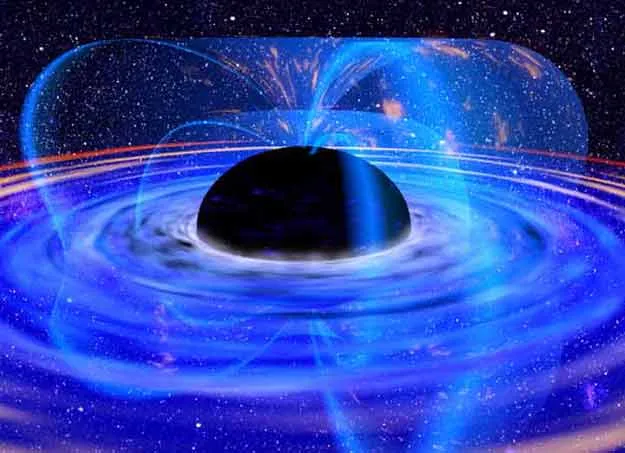
Theory says a black hole forms when a massive star runs out of fuel and the gravity of its own weight causes it to collapse into a small core. This act is often accompanied by an explosion, called a supernova. Einstein's theory shows that gravity bends light and if the collapsed supernova core is heavy enough (at least about three times more than the Sun), the result would be a black hole with gravity so strong that light could not escape its clutches, at least outside the distance called the "event horizon". Moreover, the heavier the black hole, the farther the event horizon extends.
But in 1975, Stephen Hawking and another physicist, Jacob Bekenstein, gave physicists a new headache by concluding that these collapsed stars evaporate over time, with a continuous release of particles in a simple radiation, called Hawking radiation, ever since.
The result combines Einstein's theory of gravity with quantum mechanics, which explains the behavior of subatomic particles.
Why is this a headache? Because of the famous "Information Paradox" of black holes. Basically, once something disappears into a black hole, it's gone irreversibly. Hawking's best-known example is the one that supposes throwing an encyclopedia into a black hole. Once it passes the black hole's event horizon, all the "information" of the encyclopedia -any indication of its physical characteristics- is gone forever. And, unfortunately for the encyclopedia, the black hole's Hawking radiation would not bring back information from any volume swallowed by the black hole, by definition. So, in this sense, the information (for example, the location of all the ink and paper molecules in the volume) has been destroyed.
However, this violates another principle of quantum mechanics which holds that "information" within a system cannot be completely destroyed. Hence the paradox.
Various solutions to the dilemma have emerged over the years. In 2004, Hawking himself suggested that quantum mechanics leaves open an escape hatch from its own trap, implying that the radiation contains information.
But a paper recently accepted for publication in the journal Physical Review D, goes a bit further.
Researchers Tanmay Vachaspati, Dejan Stojkovic and Lawrence Krauss from Case Western Reserve University, suggest that the event horizon never actually forms, leaving room for a kind of Hawking radiation, which would circumvent the information paradox. So black holes would slowly dissipate before truly forming.
In the paper, the team asks what a distant observer sees of a collapsing star. This is an interesting question, says Krauss, because there is a small chance that particle accelerators like CERN's LHC could see microscopic black holes forming in experiments starting in 2008. The team asks what kind of Hawking radiation would emerge from those collapses as they occur.
Since Hawking radiation takes away the black hole's mass, evaporating it, any "pre-radiation" would similarly remove mass from the collapsing star, slowly decreasing the distance between the event horizon and the black hole's center. If enough radiation escapes before the collapse, the black hole would evaporate completely before having a chance to form.
And that is what seems to happen to a black hole in collapse, the team concludes. "Instead, a true event horizon never forms in gravitational collapse," says the study. Instead of forming a complete event horizon from which light cannot escape, the black hole could be in a state of perpetual collapse that could last a very, very long time for large stars, "at least, as seen by an external observer located very far away," suggests Krauss.
"It's an intriguing result, really the beginning of a conversation," acknowledges Krauss. But since black holes are among the most interesting topics in physics, he suggests that asking questions about their properties is clearly worthwhile.
The paper's results "suggest that Hawking radiation could have a much larger effect than is commonly expected," says physicist Don Marolf of the University of California. "It would be very interesting if solid evidence could be found to support this idea."
Beyond CERN, some astrophysicists hope to see black holes in the coming decades, either microscopic ones in places like the Pierre Auger Cosmic Ray Observatory in Argentina, or the supermassive black hole believed to reside at the center of our galaxy via telescopes.
"Since the presence of an event horizon is considered the only completely unequivocal signature of a black hole (to distinguish it from a neutron star or other ultra-compact objects), the claim of this work that there are no event horizons could be important," says NASA astronomer Michael Loewenstein of the Goddard Space Flight Center, via e-mail. "It is not clear to me how astronomical observations that seem to support the existence of event horizons would be re-interpreted, and how the predictions of behavior and appearance of collapsed matter would differ," he comments cautiously.
In all these cases, we could be "seeing the gravitational collapse of matter and might not see effects associated with a black hole event horizon," concludes the study. "Only the effects occurring during the gravitational collapse itself appear to be visible."
In short, what the researchers seem to conclude is that black holes lose mass faster than they gain it, so event horizons would never manage to form.
"Non-thermal radiation can carry information in it unlike thermal radiation. This means that an outside observer watching an object collapse receives non-thermal radiation back and may be able to reconstruct all the information in the initial object and thus the information is never lost," say the researchers.
"An outside observer will never lose an object into a black hole," says Stojkovic. "If you are sitting outside and throw something into a black hole, it will remain outside the event horizon even if one considers the effects of quantum mechanics. In fact, since in quantum mechanics the observer plays an important role in measurement, the question about the formation of an event horizon is much more subtle to consider."
The physicists hasten to assure astronomers and astrophysicists that what is observed about gravity collapsing masses continues to be true, but the controversial thing about the new discovery is that "from the point of view of an external observer it takes an infinite amount of time for an event horizon to form and thus the clocks for objects falling into the black hole will appear to slow down to zero," explains Krauss, director of the Center for Education and Research in Cosmology at Case University.
Let's clarify this last point: Einstein showed that as gravity increases, time appears to go slower. If there are two people, one very close to a black hole and another farther away, the more distant person would see the other person's clock going slower. The stronger the gravity, the slower time will appear to go.
Phil Plait, on his Badastronomy blog, asks how the black hole forms then if this is the case. And he answers: "Imagine the collapsing core and you are watching it from afar. You will see it getting smaller, but the collapse will also appear to go slower, due to time dilation. Like Zeno's paradox, you would see the escape velocity approach the speed of light, but you would not see it actually ever reach it. Time would stretch infinitely and the collapse of the core would seem to you to have stopped.
Now, as noted before, Hawking radiation makes the black hole lose mass until it evaporates.
For an external observer, the event horizon would not be seen to form because it would take an infinite amount of time. Time during which the black hole is losing mass. So the two effects compete with what ultimately would be seen is that the black hole evaporates before the horizon manages to form.
In short, what the researchers seem to conclude is that black holes lose mass faster than they gain it, so event horizons would never manage to form.
We must not lose sight of the fact that, although a black hole is often defined as an ultra-compact object that possesses an event horizon, the lack of the latter does not mean the object ceases to exist.
Evidently the paper provokes controversies that should only generate more research and debate about these objects that attract so much for their power and magnificence.
Sources and related links
- USA Today:Black holes: Just beyond the event horizon
- NewScientist:Do black holes really exist?
- EurekAlert:Case researchers may have solved
- Case University: Black Holes aren't
- Word document:Agujeros negros cuánticos: la apuesta de Stephen Hawking
Carmen A. Núñez (I.A.F.E. – CONICET) - Caos y ciencia:(Black Holes) black, they play and win
- Proyecto Celestia:Videos on Black Holes
Image credit: NASA