On Saturday night, when the Sun is setting, go out and look at the Moon. You might see it much larger than usual. This is a well-known visual phenomenon called "The Moon illusion".
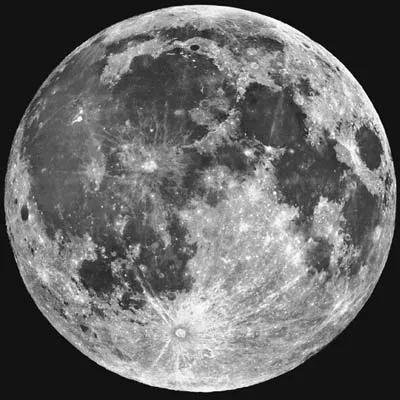
APOD - Credit: Lick Observatory
This weekend there will be a full Moon. And it will be fuller than ever, if you manage to capture this illusion that occurs, in principle, because the moon will be at a lower altitude in the sky. This is because the Sun and the Moon are on opposite sides of the sky, and when one rises the other sets. Since we just passed the solstice on June 21, the Sun is higher in the Northern skies, closer to its highest point. The Moon, on the other hand, is lower. Like other optical illusions, it depends on some factors, such as foreground objects, so not everyone manages to capture it.
The reasons why the phenomenon occurs do not seem to be entirely clear yet, as some hypotheses persist.
For example, the phenomenon is often attributed to the so-called "Ponzo illusion". In 1913, Mario Ponzo drew two identical bars over a pair of converging lines, like train tracks. The top bar looks wider than the bottom one. This seems to occur because the top bar spans a larger apparent distance between the rails.
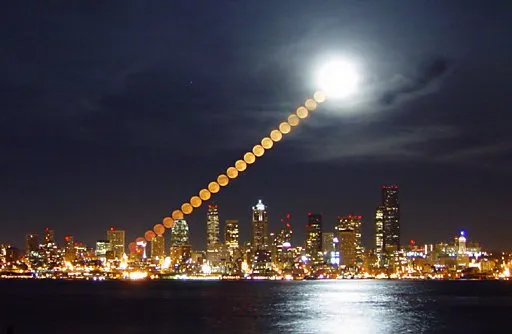
A sequence of photos of the Moon rising over Seattle. For the camera, the Moon appears to be the same size regardless of its position in the sky. Credit and Copyright: Shay Stephens.
Although this hypothesis is still often used to explain the phenomenon, assuming that foreground objects, such as trees, houses and buildings, play the role of Ponzo's converging lines. However, some airline pilots say they have also experienced the Moon Illusion, without foreground objects.
Another hypothesis is based on how we perceive the sky. Humans perceive the sky as a flattened dome, with the zenith near and the horizon far away. That makes sense; birds flying overhead are closer than birds flying on the horizon. When the Moon is near the horizon, the brain, trained by the action of looking at birds (and clouds and airplanes), does not correctly calculate the actual distance to the Moon, nor its size.
But the hypotheses do not stop here (See related links). There are several others, but the phenomenon occurs and is worth experiencing.
The Ponzo Illusion. Image Credit: Dr. Tony Phillips
Sources and related links
- The largest full moon in the last 18 years... is mere illusion
- Moon Illusion on Wikipedia
- Science@Nasa: Summer Moon Illusion
- La Plata Observatory Bulletin 133
- THE MOON ILLUSION EXPLAINED (The Moon Illusion explained, in English)