NASA's X-ray observatory, Chandra, has revealed an X-ray jet from a neutron star in a binary system. The discovery could help astronomers understand how neutron stars and black holes can generate powerful streams of relativistic particles.
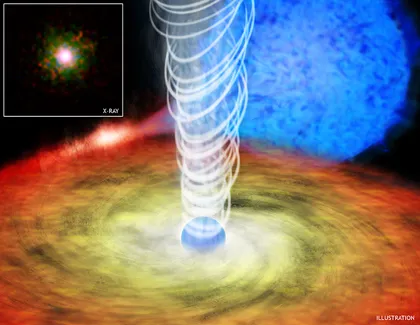
Illustration credit: X-ray: NASA/CXC/Univ. of Wisconsin-Madison/S.Heintz et al.; Illustration: NASA/CXC/M.Weiss
The jet was found in Circinus X-1, a system in which a neutron star is in orbit around a star several times the mass of the Sun, about 20 thousand light-years from our planet.
A neutron star is an extremely dense remnant of an exploded star, consisting of tightly packed neutrons.
Many jets have been found originating near black holes -of both classes, supermassive and stellar-sized- but the Circinus X-1 jet is the first associated with a neutron star in a binary system. This detection shows that the unusual properties of black holes -such as the presence of an event horizon- may not be necessary to form powerful jets.
Furthermore, the finding reveals how efficient neutron stars can be.
"Gravity seems to be the key in creating these jets, not some trick of the event horizon," says Sebastian Heinz of the University of Wisconsin in Madison, who led the study.
Heinz and his colleagues found that a surprisingly high percentage of the available energy from material falling onto a neutron star is converted to power the jet.
"In terms of energy efficiency across the Universe, this result shows that neutron stars are near the top of the list," adds Norbert Schulz, co-author, from the Massachusetts Institute of Technology in Cambridge. "This jet is almost as efficient as one from a black hole."
The results also help explain the origin of diffuse radio emission lobes previously detected around Circinus X-1. The team found that the X-ray jets of high-energy particles are powerful enough to create and maintain those radio emission gas bubbles.
"We have seen huge radio clouds around supermassive black holes in the centers of galaxies," comments Heinz, and continues, "What is unusual here is that the small version, relatively speaking, is being powered by a neutron star, not a black hole."
The main evidence for the newly discovered jet comes from two extensive Chandra features.
These two fingers of X-ray emission are separated by about 30 degrees and could represent the outer walls of a wide jet. When compared with radio images, these X-ray features, which are at least 5 light-years from the star, closely follow the outer line of the radio jet.
Another interpretation is that they represent two separate jets produced at different times by a precessing neutron star. That is, the star wobbles and the jet fires at different angles at different times.
The precession of the jet is also consistent with radio observations taken at different times, which show varying orientation angles of the jet. If the precession scenario is correct, Circinus X-1 could possess one of the largest jets found to date in binary systems, representing another way in which neutron stars can rival black holes.
These results will appear in the next issue of The Astrophysical Journal Letters.
Sources and related links
- Chandra press release
- Note on EurekAlert
- The star that mimics a black hole
- The Chandra Circinus X-1 Page