Dramatic changes are taking place in the atmosphere of the giant planet that had never been seen before with the great "eye" of the Space Telescope.
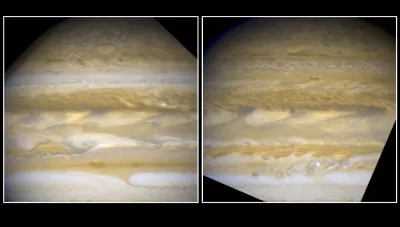
Credit: NASA, ESA, A. Simon-Miller (NASA Goddard Space Flight Center), A. Sánchez-Lavega, R. Hueso, and S. Pérez-Hoyos (University of the Basque Country), E. García-Melendo (Esteve Duran Observatory Foundation, Spain), and G. Orton (Jet Propulsion Laboratory)
Jupiter's turbulent clouds are always changing as they encounter atmospheric disturbances while they circle the planet at hundreds of miles per hour. But these Hubble images reveal a rapid transformation in the shape and color of the planet's clouds near the equator, covering a full face of the globe.
The planet is wrapped in bands of yellow, brown, and white. These bands are produced by the atmosphere flowing in different directions at various latitudes. The light areas where the atmosphere rises are called zones. The darker ones, where the atmosphere falls, are called belts. When these opposing flows interact, storms and turbulence appear.
Between March 25 and June 5, Hubble's Wide Field and Planetary Camera 2 captured entire bands of clouds changing color. Zones darkened into belts and the latter transformed into zones.
The image on the left shows a thin band of white clouds over the planet's equator. The white color indicates clouds at high latitudes in Jupiter's atmosphere. In the image on the right, the band turned brown, showing deep clouds in the atmosphere. The entire band appears to have merged with the one below it.
In the same cloud over the equator, the small swirls in the left image changed into larger, wave-like shapes in the right image. Dominating the band is a dark streak that looks like a snake. This structure is a small break in the cloud cover, which gives astronomers a deep view of the atmosphere.
Below the equatorial region, in the left image, there is a brown band, like an upside-down shark fin, that disappears in the other photo.
These global upheavals have been seen before, but not with the sharp resolution of the Hubble Space Telescope. Astronomers had seen dramatic transformations in the '80s using ground-based telescopes. In the early '90s a large atmospheric disturbance was also seen, after Hubble's launch, but it did not have the resolution to see the phenomenon in fine detail. These high-quality images could help astronomers understand how these global changes develop in Jupiter's atmosphere.