The model incorporates black holes, which helps predict where to locate future telescopes.
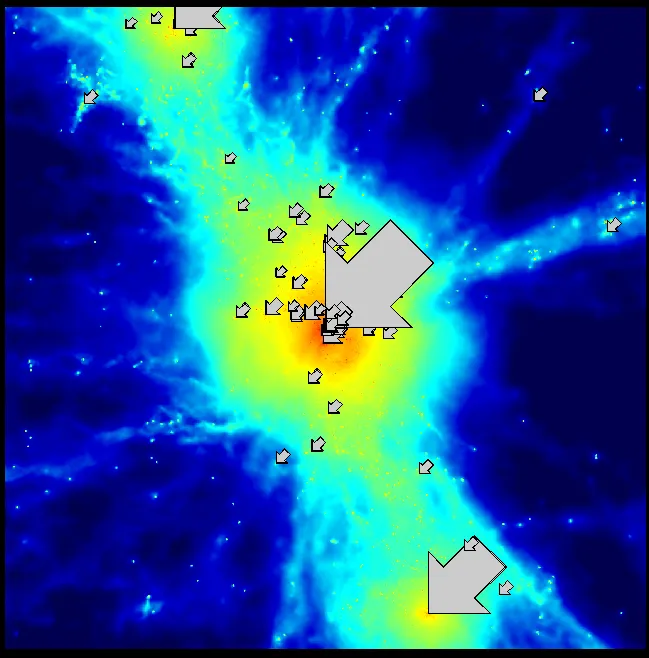
Galaxies up close
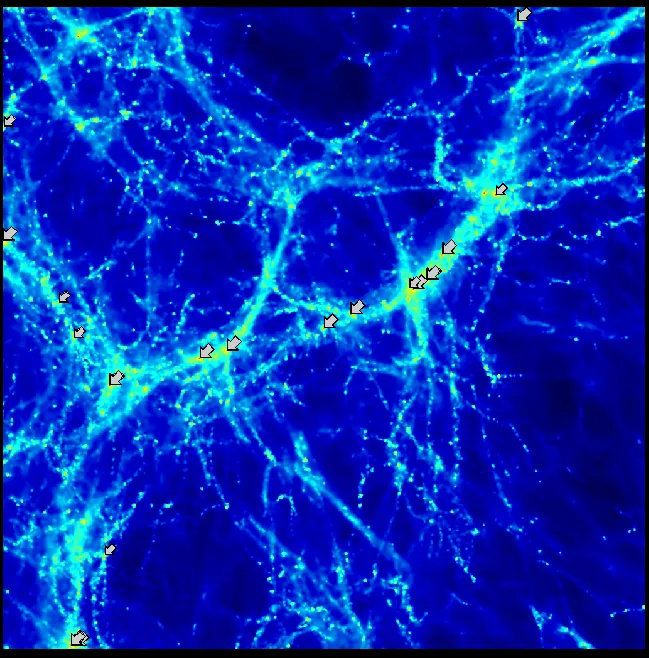
This simulation image is a close-up of the host galaxy of the most massive black hole in the current universe.
By incorporating the physics of black holes into a highly sophisticated model running on a supercomputer, an international team of scientists produced an unprecedented simulation of cosmic evolution that verifies and deepens our understanding of the relationships between black holes and the galaxies in which they reside. Called BHCosmo, the simulation shows that black holes are essential to the structure of the cosmos and can help guide future telescopes, showing them what to look for when trying to locate the earliest cosmic events and untangle the history of the universe. The research team is led by Carnegie Mellon University and includes scientists from the Harvard-Smithsonian Center for Astrophysics and the Max Planck Institute for Astrophysics. The research is about to be published in The Astrophysical Journal.
"Ours is the first simulation that incorporates the physics of black holes," says Tiziana Di Matteo, a theoretical cosmologist and associate professor of physics in Carnegie Mellon's College of Science. "It is a computational challenge that involves more calculations than any previous similar model of the cosmos, and the result gives us the best picture to date of how the cosmos formed."
Di Matteo performed her simulation using the Cray XT3 system at the Pittsburgh Supercomputing Center (PSC), the most powerful system available.
Experimental observations reveal that black holes are important regulators of galaxy formation and, ultimately, the factory of the current universe, according to the researcher. However, previous simulations did not take black holes into account because the computational demand was prohibitive.
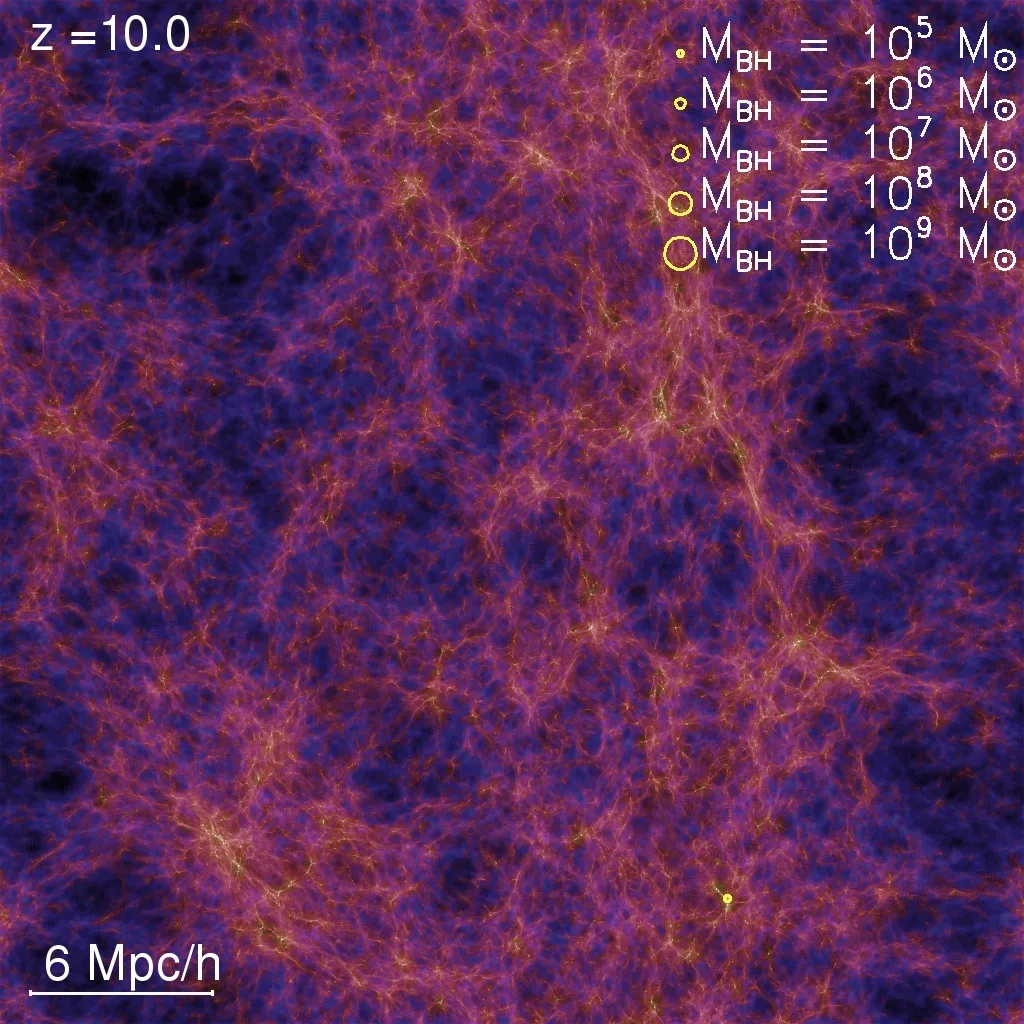
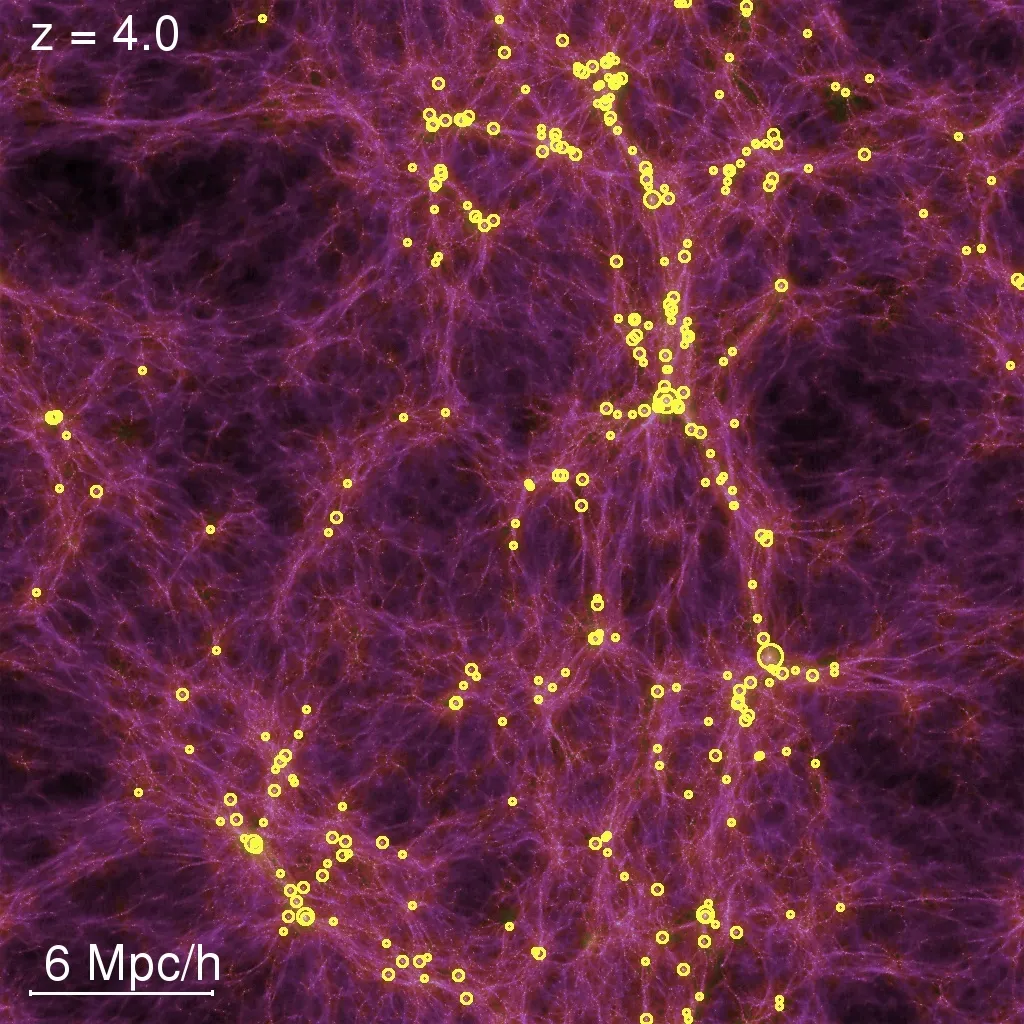
The projected distribution of gas density and black holes (shown as yellow circles) at different cosmological redshifts (Z).
"Including black holes in computational simulations is critical. The galaxies we see today look that way thanks to the physics of black holes," adds Springel, a junior researcher at Max Planck. "We must do simulations to understand the role that black holes played in forming structures both in the early universe and in the current one."
Large black holes, called supermassive, are found in the centers of galaxies. They may initially originate when the first stars collapsed under their own gravity. Surrounded by dense gas, they consume the material, gas and stars and rapidly grow to monstrous sizes, some with masses of billions of suns. But evidence suggests that supermassive black holes self-regulate - they do not feast eternally and do not "swallow" an entire galaxy, says Di Matteo.
In her simulation, as in reality, galaxies routinely collide.
The supermassive black holes hidden in the centers of these galaxies choreograph the dynamics of the galactic collision. The result is a tremendous burst of energy produced when the black holes merge and form a luminous state called a quasar. "The formation of quasars really captures when the fun happens in a galaxy," says Di Matteo. "You can only use a simulation to follow a complex, non-linear history like this to understand how quasars and other cosmic structures originate."
The simulation covered multiple time and space scales up to 100 million light-years, which is impossible without a supercomputer like the XT3.
The simulation set the initial conditions to reflect the cosmic microwave background radiation produced at the birth of the universe. Then the simulation was seeded with a quarter of a billion particles representing matter. For the simulation, Di Matteo used fluid spheres to represent chunks of matter like gas. This step was essential so that the researchers could calculate all the physical forces on these chunks. The gravity exerted by dark matter was also taken into account. Additionally, her calculations accounted for the forces associated with various cosmic phenomena, including black holes and exploding stars.
Implications:"We believe our work has profound implications for cosmology," says the scientist.
For the computation to be possible, the scientists used 2,000 processors - the entire system - of the Cray XT3 for four weeks of computing time. Even with all that computing power, special techniques were required to compute all the gravitational forces involved. For example, a "tree" was built in which nearby cosmic particles occupied the same "branch" and nearby branches were related. By computing the forces on the particles of the entire tree, the number of calculations required was reduced by a factor of a few million to something manageable.
The result allows scientists to easily follow the collapse of galaxies. "We believe our work has profound implications for cosmology," says the scientist. "We have found that the most massive early black holes are not the ones we see today, so simulating the dynamic evolution of these structures is critical to understanding cosmic history."
"With our simulations, we can predict what the next generation of telescopes should see when looking back 13 billion years in time, just after the Big Bang."
The scientist hopes to be able to perform her next simulations on more powerful computers and be bold enough to model the entire universe on the scales observed with the Sloan Digital Sky Survey (SDSS). The SDSS is the largest survey of the cosmos that has cataloged nearly 100 million galaxies to date.
In addition, Di Matteo is working with Carnegie Mellon's computer science faculty to develop faster ways to combine the physics of the very large with the very small in the same calculations using a set of tools called dynamic meshing.
Sources and related links
About the images:
Galaxies up close
This simulation image is a close-up of the host galaxy of the most massive black hole in the current universe.
This massive elliptical galaxy is at the center of a large galactic cluster. About 600 million years after the big bang (on the left), matter is more diffuse than about 4.5 billion years later. Gas density increases from blue to red, and the arrows indicate black holes (the size of the arrow is proportional to the mass).
EurekAlert:Carnegie Mellon University-led team conducts most detailed cosmological simulation to date
Paper: Direct cosmological simulations of the growth of black holes and galaxies
The BHCOSMO: Simulating black hole and galaxy formation along cosmic time
Fixing the holes