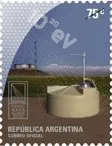
Correo Argentino will launch in July a stamp featuring the Pierre Auger Observatory.
Via La Nación
The Pierre Auger Observatory, in the province of Mendoza, is part of a large-scale scientific project involving Argentina, Australia, Bolivia, Brazil, the Czech Republic, Germany, France, Italy, Mexico, Poland, Slovenia, Spain, the UK, the USA and Vietnam.
The objective is the study of cosmic rays, particularly the very energetic ones, that is, whose energy exceeds 1020 electron-volts.
Our planet constantly receives a shower of charged particles.
Every second 1000 particles per square meter hit the outermost layers of the Earth's atmosphere.
This flow of particles (called cosmic rays), coming mostly from our Galaxy, consists of 90% protons, 9% alpha particles (helium nuclei) and the rest are nuclei heavier than hydrogen.
The term "Cosmic Rays" refers to elementary particles, nuclei, and electromagnetic radiation of extraterrestrial origin. These can include exotic particles, such as muons, pi mesons or lambda baryons.
The most important source of cosmic rays are supernovas in our galaxy.
Cosmic Rays with energies greater than ~1018 eV are called "Ultra High Energy Cosmic Rays" (UHECR). These are microscopic particles with macroscopic amounts of energy on the order of joules (one electron-volt is approximately equivalent to 1.6x10⁻¹⁹ joules) or more.
The three fundamental questions related to these particles are:
How are they accelerated to reach these extreme energies?
Where do these Cosmic Rays come from?
What is their composition?
To study the acceleration mechanisms, careful measurements of the energy spectrum of Ultra Energetic Cosmic Rays must be made in order to compare with the predictions of the different acceleration models
To understand where they come from, a detailed survey of the arrival directions is needed and anisotropies in their distribution must be sought, both on small and large scales.
Composition is one of the most complicated measurements, because Ultra High Energy Cosmic Rays cannot be detected directly using traditional particle detectors. Therefore, the composition can only be inferred from auxiliary measurements.
Besides supernovas, in a galaxy there are other sources of energetic particles, such as: black holes, neutron stars or pulsars (the bare nucleus of a star that exploded as a supernova), the collision between two neutron stars. There are several objects in the sky from which strong emissions of Cosmic Rays would be expected.
For example, these emissions are possible around galaxies that are colliding, such as NGC 4038/9.
However, there is still no evidence indicating that these objects are sources of ultra high energy cosmic rays! Another class of objects that are candidates for sources of Ultra Energetic Cosmic Rays are Active Nucleus Galaxies (AGN).
These galaxies present jets of material that can extend between 50 and 100 thousand light-years away.
It is always possible to find an AGN in the direction of ultra energetic cosmic rays, within the observational error.
Despite this, there is still no evidence indicating that these galaxies actually produce the cosmic rays that are the object of study of the Auger Observatory
* An electron-volt is a microscopic unit that corresponds to the energy gained/lost by an electron in crossing a potential jump of 1 V (volt). A common battery (AA used in a TV remote control) has a voltage difference of 1.5 V. A 40 W (watt) light uses about 1024 eV of energy in one hour.
Report on the "Pierre Auger Cosmic Ray Observatory"
Philately and astronomy
Stamp:
Cherenkov radiation detector of the Pierre Auger Observatory, located in the departments of Malargüe and San Rafael, Mendoza. Fluorescence detector building. Expression representing the energy of ultra-energetic cosmic rays. Observatory logo.
Correo Argentino