Stars in dwarf spheroidal galaxies behave in a way that suggests the galaxies are completely dominated by dark matter, according to new research.
Astronomers Mario Mateo and Matthew Walker of the University of Michigan measured the velocity of 6,804 stars in seven dwarf satellite galaxies of the Milky Way: Carina, Draco, Fornax, Leo I, Leo II, Sculptor and Sextans. They found that, contrary to what Newton's law of gravitation predicts, stars in these galaxies do not move slower the farther they are from the galactic nucleus.
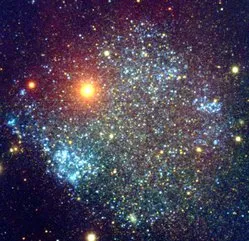
Dwarf galaxy Sextans
Astronomers already knew that stars in spiral galaxies behave similarly. This research dramatically increases the information available about minor galaxies, making it possible to confirm that the distribution of light and stars is not the same as the distribution of mass.
"Our research shows that dwarf galaxies are dominated by dark matter," says Walker.
Dark matter is a substance that astronomers have not observed directly, but its existence is deduced by detecting its gravitational effects on visible matter.
Dark matter is thought to hold galaxies together. The gravitational force of visible matter is not considered strong enough to prevent stars from escaping. There are, however, theories that attempt to explain these discrepancies. For example, Modified Newtonian Dynamics, says Mateo, proposes that gravitational forces become stronger when accelerations are very weak. Although the research results align with current dark matter models, Mateo and Walker say they also reinforce this less popular explanation.
"These dwarf galaxies may alter our understanding of the nature of dark matter and, perhaps, even of gravity."
The paper with the discoveries was published in the September 20 issue of Astrophysical Journal Letters.
Sources and related links
- Note on EurekAlert
- Press release at U. Michigan