A new model to describe the structure of galaxies
In a recent article in MNRAS, Argentine scientists from the Observatoire de Paris and the Université Pierre et Marie Curie describe the main observed properties of galaxies with a new theory.
The universe is composed mostly of dark matter, distinct from ordinary matter and which manifests through the action of gravity.
The proportion of dark matter in the total mass of galaxies varies according to their sizes: 95% for large spiral or elliptical galaxies and up to 99.9% in compact dwarfs.
In such proportions, dark matter and gravity play a decisive role in the formation and structure of galaxies.
Using a theory that involves those two components, a team of scientists, which includes two Argentines residing in Paris, managed to reproduce the observed properties of galaxies, that is, their circular velocity, density distribution, as well as the relations between their masses, sizes and velocities.
Warm dark energy
The theoretical approach is based on the supposed existence of "warm" dark matter, as opposed to "cold". It would be composed of particles with masses on the scale of kilo electron volts (eV or keV, equivalent to 10-33 kg, an electron has a mass of 511 keV). In the "cold" version the particles are heavier and slower.
The work is based on the quantum properties of this matter, such as spin and particle statistics: a repulsive pressure is generated against the attractive action of gravity.
For the work, ten different sets of galaxy data were used, each set with galaxies of masses between 5x10⁹ to 5x10¹¹ solar masses.
The obtained circular velocities (rotation curves) and density distributions are consistent with those observed. And a notable fact: the normalized theoretical rotation curves and density profiles are universal: they are the same for all galaxies of different type, size and mass.
Compact dwarf galaxies approach the Thomas-Fermi model, while intermediate galaxies (spirals, ellipticals and others) approach the classical Boltzmann model.
The warm dark matter simulations done so far are classical: quantum dynamics is not used, but Newton's equations. Therefore, in galactic nuclei, below ~100 pc, those N-body simulations without quantum pressure exhibit small nuclei with sizes smaller than observed. The relevant quantum effect for these scientists, according to previous work, is fermionic pressure.
When this effect is taken into account, the theory predicts correct structures, according to what is observed.
In the paper, which can be accessed for free, the work is structured with a presentation of the problem; then in section 2 the Thomas-Fermi approach is addressed; then observations are contrasted with theoretical data; and finally conclusions are drawn.
The kinematics of several thousand galactic disks, described by their rotation curves and other parameters, show that the density of dark matter halos around galaxies of different types, luminosities and morphology are well represented by the so-called Burkert Profile.
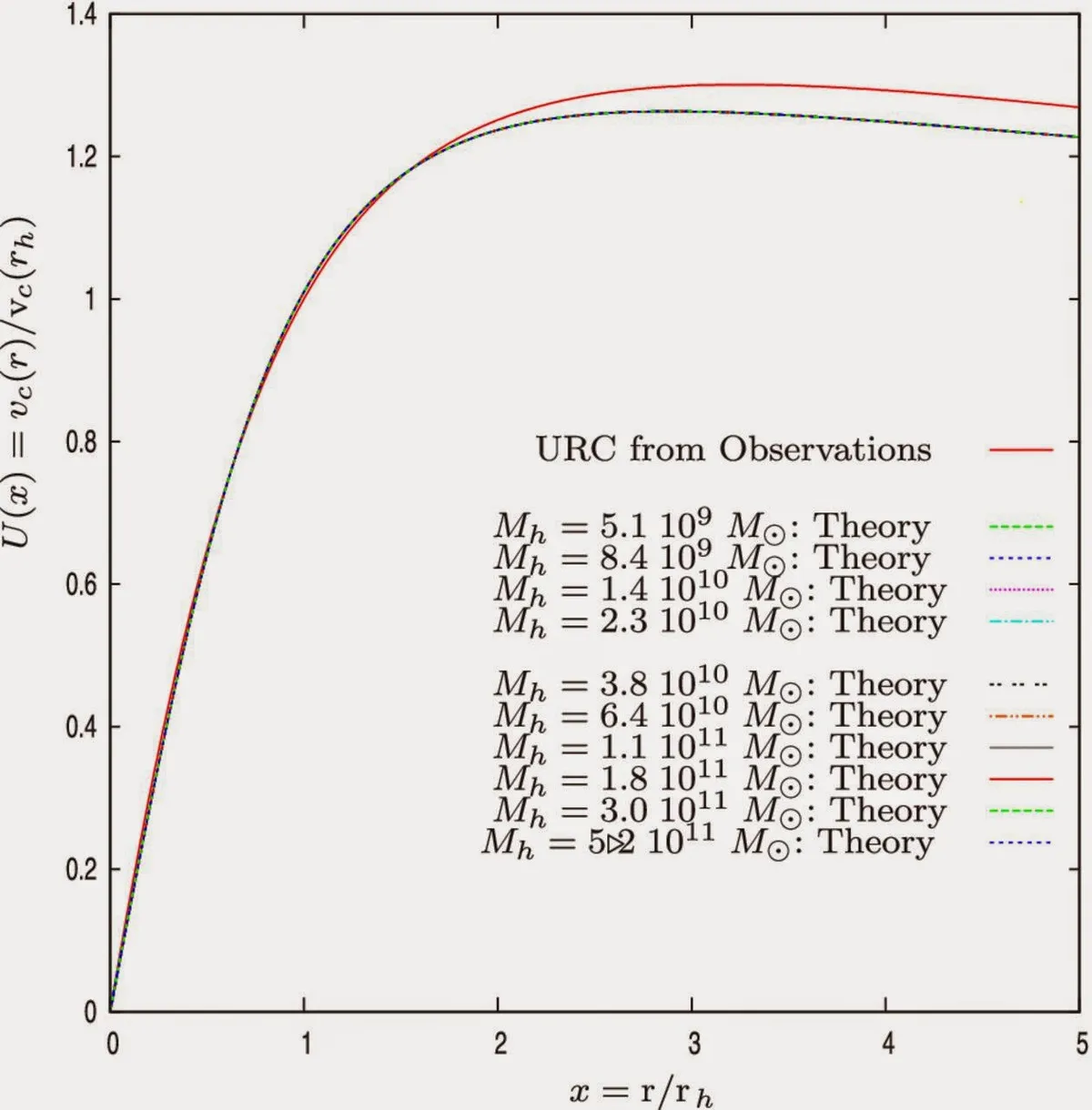
Figure 2 shows the normalized circular velocities from observational data and those arising from the Thomas-Fermi formula. URC means universal rotation curve (see Salucci et al. 2007).
Conclusions
The theoretical physicists conclude that the best way to decipher the nature of dark matter is to study the properties of the physical objects formed by it: galaxies.
Fermionic warm dark matter (WDM) by itself produces galaxies and structures in agreement with observations modeled with the Burkert profile showing that baryonic corrections to WDM are not very important.
The results show the usefulness of the Thomas-Fermi approach to describe galaxy structures.
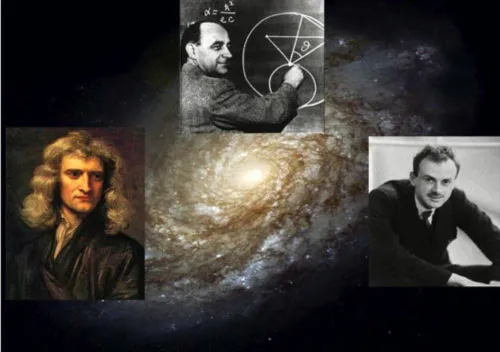
The new approach unites gravity and the quantum properties of dark matter. It has its counterpart in the statistical approach used for atoms (known as Thomas-Fermi), with gravity playing the role of the electric potential. In other words, "Newton, Fermi and Dirac, are found in galaxies through dark matter", points out Norma Sánchez, co-author of the work.
The work is signed by H. J. de Vega (UPMC), P. Salucci (SISSA/ISAS-INFN) and Norma. G. Sanchez (Observatoire de Paris, LERMA)
Héctor José de Vega is Argentine, born on April 10, 1949. He earned his doctorate in physics at UNLP (1973) and has worked as a researcher at CNRS since 1980. He also holds French nationality.
Dr. Norma Graciela Sánchez is also Argentine, born in Ensenada. In 2009 the GEN presented a project to declare her an illustrious citizen of the Province of Buenos Aires. The project reports on her career.
Sources and related links
- "Observational rotation curves and density profiles versus the Thomas-Fermi galaxy structure theory", H. J. de Vega; P. Salucci; N. G. Sanchez Monthly Notices of the Royal Astronomical Society 442 (2): 2717-2727 (2014)
DOI:10.1093/mnras/stu972 - Observatoire de Paris: A new model to describe the structure of galaxies
- Fermionic Warm Dark Matter and the Thomas-Fermi galaxy structure
theory (PDF), H.J. De Vega, LPTHE, CNRS/Universite P & M Curie (Paris VI), 18th Paris Cosmology Colloquium 2014, Observatoire de Paris, Paris campus
About the images
- Image from Observatory of Paris.
- Figure 2. Credit: H. J. de Vega; P. Salucci; N. G. Sanchez Monthly Notices of the Royal Astronomical Society 442 (2): 2717-2727 (2014)