Only one year after the start of its scientific operations, the AKARI satellite continues to produce amazing images of the universe in infrared.
Launched in February 2006, AKARI is conducting a detailed survey of the sky in infrared, helping to understand the formation and evolution of galaxies, stars and planetary systems. The mission is a project of the Japanese space agency (JAXA) with ESA and international participation.
In the course of the last year, AKARI performed observations of the entire sky at six wavelengths. More than 90% of the sky has already been observed. The mission provides the first census of the infrared sky since the atlas made by the only infrared predecessor, the IRAS satellite, more than 20 years ago.
The latest results presented by JAXA show the sky in infrared with unprecedented spatial resolution, in particular, many regions of active star formation.
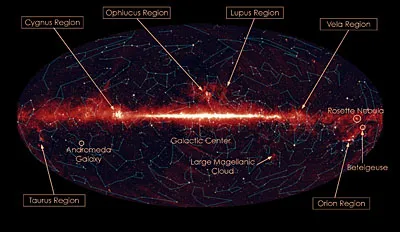
The top image in this note shows the entire sky in infrared at 9 micrometers. The bright band extending from left to right is the disk of the Milky Way. Many bright regions corresponding to strong infrared radiation appear along or near the galactic plane. These regions are sites of star birth.
The labels indicate constellations and regions of intense star formation. The data used to create this image have a spatial resolution of about 9 arcseconds, several times finer than that of IRAS in 1983.
The bright spot in the lower right part of the image, labeled "Large Magellanic Cloud", shows another galaxy close to ours, also with active star formation. This is the Large Magellanic Cloud.
The satellite's Far Infrared Surveyor (FIS) instrument also observed the Milky Way and the Orion region. In the image shown below these lines, two views (in optical, left and infrared, right) are juxtaposed, both covering a region of about 30x40 square degrees. The AKARI view is taken at 140 micrometers, the first time coverage of the Orion region in infrared waves above 100 micrometers is provided with such good resolution.
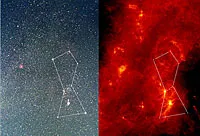
The right side of the image covers the constellation of Orion while the left side shows Monoceros. The Galactic Plane is located from top to bottom on the left side of the image. Cold dust in the Galactic Plane appears as diffuse radiation across the entire image.
The bright source just below Orion's belt shows the famous Orion Nebula (M42), where many stars are being born. Another large star-forming region including the Horsehead Nebula can be seen on the left side of Orion's Belt. In contrast to appearing as a dark cloud in visible light, it is extremely bright in infrared. The bright emission seen in the middle left part of the image is the so-called Rosette Nebula, another region of star formation. Finally, the large circular structure centered on Orion's head is clearly visible. Apparently many massive stars were formed at the center of the circle, causing a corresponding series of supernovae that removed the dust and gas in the region forming a shell-like structure.
The Orion Nebula is located about 1,500 light-years and the Rosette Nebula about 3,600 light-years from Earth.
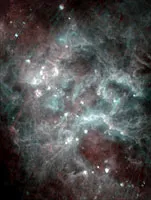
The following image is a false-color composite taken by the FIS instrument at 90 and 140 micrometers. It shows star-forming regions in the constellation Cygnus, one of the brightest in the galaxy. The image covers 7.6 x 10 square degrees. This region is in the direction of the so-called Orion Arm, one of the spiral arms of our galaxy. Many objects at distances of 3 thousand to 10 thousand light-years are projected into this small region. The Galactic Plane appears from top left to bottom right.
The many bright spots reveal star-forming regions. The stars ionize the gas and heat the dust in their vicinities producing strong infrared radiation. There are only a small number of regions in our galaxy that exhibit so many regions of massive star formation in a restricted area of the sky.
The large gaps are produced by clusters of massive stars whose radiation blew away the gas and dust from that region.
Sources and related links
- ESA press release
- AKARI