The new study allows characterizing density waves, which consist of regions in the galactic disk where the mass density is 10% to 20% greater. Stars, dust, and gas move through the density waves like cars in a traffic jam. Furthermore, it would allow understanding why galaxies can transform from being of the flattened disk type to being elliptical, through the paradigm of secular evolution.
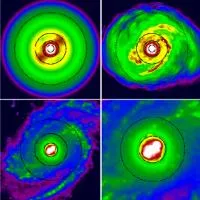
Near-infrared processed images of NGC 4321 by Dr. Xiaolei Zhang and Dr. Ronald Buta
In a paper published in The Astronomical Journal (133:2584-2606, June 2007) Dr. Xiaolei Zhang, of the Naval Research Laboratory, and Dr. Ronald J. Buta, of the University of Alabama, report having developed a precise and broad method to describe density waves in galaxies.
Density waves in the different regions of the galactic disk frequently appear as segments of patterns (bars, spirals) with a fixed speed. Using near-infrared light as a density tracer, the new method allows empirically determining the speed of these segments by calculating the gravitational field produced by these density segments.
Furthermore, they confirm that the process called "secular dynamical evolution" can transform the shapes of galaxies throughout their lives. This provides an important link for our understanding of how galaxies formed and evolved in the universe.
Galaxies can be grouped into two classes: galaxies with flattened disks, like the Milky Way, and elliptical galaxies. There are, however, infinite numbers of shapes in between characterized by the bulge-to-disk ratio (the bulge is the central part of galaxies). This trend of variation in morphology is reflected in the famous morphological classification developed by Edwin Hubble in the early twentieth century.
Observations in recent decades showed that there are more disk galaxies and fewer bulge galaxies the farther one looks (in astronomy, the farther away, the further back in time one looks, since it takes light -of finite speed- more time to arrive). So the hypothesis has been that a large number of disk galaxies are transformed into bulge galaxies. But scientists had not established how the process occurred.
In the past, mergers between galaxies were proposed as the major mechanism for transforming disk galaxies into elliptical ones. But the observed merger rate is very low and mergers do not preserve the outer disks of galaxies. Despite these and other inconsistencies, the paradigm of galactic mergers remains the most popular mechanism to account for the morphological evolution of galaxies.
In contrast, the paradigm of secular evolution is a more recent proposal. This model describes how slow and regular evolution occurs in individual galaxies. Similar to the effect of water action over a long period of time in carving gorges and canyons, the imperceptible action of secular evolution can have a powerful impact on morphological transformation over the lifetime of a galaxy. Since the 1970s, several astronomers have speculated about the existence of this phenomenon.
Dr. Zhang carried out the first systematic exploration of the dynamics of secular evolution in the late '80s and in the following decade. The results were published in a series of articles in The Astrophysical Journal. Those works showed that the rate of secular evolution is strongly enhanced by the presence of density wave patterns, with the strength of these density waves related to the interactions of gravity between the galaxy and its environment. As a result of the interaction between the density wave and the disk of matter, the matter in the inner region of the disk (including stars and gas), gradually loses its rotational energy towards the central region, so the central region increases in size and eventually becomes more and more an elliptical galaxy. This model, however, was objected to on the grounds that most stars in the most massive bulges are old and do not appear to have formed from recent gas accretion disks.
In the new model, corrected to add accretion, the shape of the central region of a galaxy can be built later than the population of stars. Thus, the accretion process can be seen alternatively as a process of creation and contraction of the inner region of a galaxy over time.
Zhang's predictions had not been quantitatively compared with the observed properties in galaxies until the recent work with Buta. By calculating the accretion rate of galactic disks using images obtained by ground-based telescopes, as well as Spitzer, the scientists confirm for the first time the magnitude and thus, the significance of the secular evolution process in the transformation of galactic morphology. The new results show that for most observed galaxies, the level of secular evolution is sufficient to create the bulges in their lifetimes.
Sources and related links
- EurekAlert and Physorg:Significant new method developed for characterizing density wave features
- THE POTENTIAL-DENSITY PHASE-SHIFT METHOD FOR DETERMINING THE COROTATION RADII IN SPIRAL AND BARRED GALAXIES, XIAOLEI ZHANG,Remote Sensing Division, US Naval Research Laboratory, Washington, DC 20375, USA AND RONALD J. BUTA, Department of Physics and Astronomy, University of Alabama, Tuscaloosa, AL 35487, USA. Received 2006 October 20; accepted 2007 February 11; published 2007 April 20
- Density waves
- Density waves and galaxy evolution (PDF)
- Astroseti:Rebeldes con causa