To see new galaxies...without leaving your chair! An experiment launched today, called Galaxy Zoo, offers the possibility of helping to unveil the mysteries of galactic formation. All that is needed is a computer and a pair of eyes.
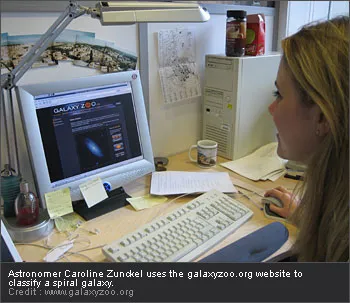
The project, called Galaxy Zoo, is recruiting volunteers to help in the largest galactic census ever conducted. Around one million galaxies will be scrutinized to categorize them into the different types.
The results will help answer how galaxies form and to determine whether or not there is a pattern in spiral galaxies.
The idea of shared scientific data analysis is not new. Several experiments of this kind exist, from programs for the search for extraterrestrial life (SETI) to those for new cancer drugs.
However, these projects use the spare time of volunteers' computers. Galaxy Zoo is different: it uses the users' brains.
The project's website hosts around one million images captured by the Sloan Digital Sky Survey, a project to map a quarter of the sky. The team, based at the University of Oxford, aims to assign each image to one or two main types of galaxies: spiral, like ours, or elliptical.
That means recognizing the presence or absence of spiral arms and judging whether they rotate clockwise or counterclockwise.
To search for patterns
"The human brain is actually much better than a computer at these pattern recognition tasks," says team member Kevin Schawinski.
Opening the project to amateurs means taking this boring task away from astronomers and achieving faster classification, which could be complete in months instead of years.
To take part in the study, an online tutorial is included explaining the different types of galaxies, followed by a short test to prove you're doing it right. After that, all that's left is to classify galaxies that perhaps no one has seen before.
"Most of these galaxies have been photographed by robotic telescopes and then processed by computers, so this is the first time they will be seen by human eyes," explains Schawinski.
Mapping the distribution of spiral galaxies could help cosmologists find out if galaxies in certain areas of the sky rotate in a particular direction.
Previous studies suggest that galaxies in one portion of the sky are more likely to rotate clockwise, while galaxies in the opposite direction rotate counterclockwise, says Kate Land, a colleague of Schawinski.
This could mean that the galaxies would be rotating on a magnetic axis through our portion of the universe, so we see those on one side as rotating in one direction and those on the other side rotating in the opposite direction.
Only a few hundred galaxies have been studied so far, so the results are not yet reliable. If the Galaxy Zoo project finds a similar pattern, it will give cosmologists the headache of looking for a theoretical explanation.
"If the galaxies are rotating in the same direction it will be very interesting, although it will make things more difficult," says Land. Things would be simpler to explain if the distribution is random.
Sources and related links
- Nature: See new galaxies — without leaving your chair, by Michael Hopkin
- Space.com: Online Help Sought to Organize Galaxies By Raphael G. Satter
- Press release on GalaxyZoo
- Astronomer Caroline Zunckel uses the galaxyzoo.org site to classify a spiral galaxy. Credit: www.galaxzoo.org